
In the field of vacuum technology, the rotary vane vacuum pump is one of the most fundamental and widely used vacuum pumps, often described as the "lung" of industrial manufacturing and scientific experiments. You may frequently hear the terms single-stage rotary vane vacuum pump and two-stage rotary vane vacuum pump. What exactly is the difference between them? Which one is more suitable for your equipment? Today, we will use this article to thoroughly clarify this issue.
1. What is a rotary vane vacuum pump?
To understand the difference between the two, we must first grasp their common "underlying logic". A rotary vane vacuum pump is a type of positive displacement pump, and its core working principle is not complicated:
Core structure: A cylindrical rotor is eccentrically mounted inside the pump chamber. The rotor has two (or more) slots, and vanes can slide freely within these slots.
Key action: When the motor drives the rotor to rotate, under the influence of centrifugal force and spring thrust, the tips of the vanes always slide against the inner wall of the pump chamber.
Working process: Due to the eccentric rotor, several crescent-shaped spaces are formed between it and the pump chamber. As the rotor turns, the volume of these spaces changes periodically – when the volume increases, gas is drawn in through the inlet; when the volume decreases, the gas is compressed and finally pushed out through the exhaust valve to the atmosphere, thus achieving continuous pumping.
Rotary vane pumps are mostly small to medium-sized and are widely used in many fields such as metallurgy, electronics, chemicals, pharmaceuticals, food packaging, vacuum coating, laboratory instruments, and more.
2. The difference between single-stage and two-stage
Now that we understand the basic principle, we can answer the core question. The so-called two-stage, as the name suggests, structurally connects two single-stage pumps in series.
*Note: The "two-stage" here essentially means two stages connected in series, each stage having a single-stage pump structure; it is not simply a doubling of a single working chamber.*
2.1. Ultimate vacuum – the most critical difference
This is the most essential difference between the two, directly determining their application fields.
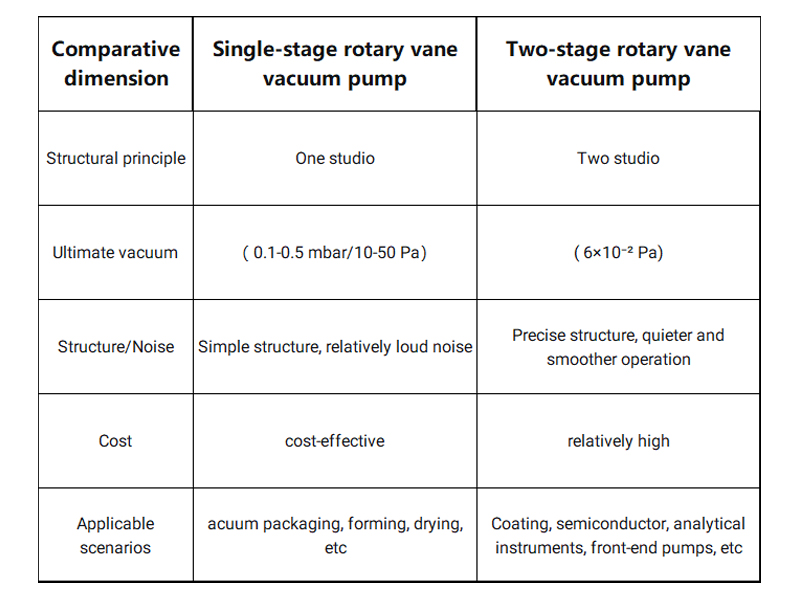
Single-stage rotary vane vacuum pump: Has only one working chamber, resulting in a relatively low ultimate vacuum, typically reaching 0.1-0.5 mbar (approx. 10-50 Pa). It is generally suitable for rough and low vacuum applications with less stringent vacuum requirements.
Two-stage rotary vane vacuum pump: Gas passes through two working chambers successively. The first stage (low-pressure stage) extracts and pre-compresses the gas, then sends it to the second stage (high-pressure stage) for secondary extraction and further compression. This "relay-style" pumping structure significantly improves the ultimate vacuum, generally reaching below 6×10⁻² Pa (i.e., 0.06 Pa), which is hundreds of times higher than that of a single-stage pump.
2.2. Structure and noise
Structural complexity: Single-stage pumps have a simple structure and are easy to maintain; two-stage pumps are more precise and complex due to their two independent pump stages and associated air paths.
Noise and vibration: Single-stage pumps generate relatively high noise during operation due to direct exposure to exhaust pressure and oil flow impact. In contrast, when a two-stage pump operates in the high vacuum stage, the absence of high oil flow rates from the atmospheric stage results in lower hydraulic noise, making operation quieter and smoother. The design features of two-stage high-speed direct-coupled structures also include small size, light weight, low noise, and low vibration.
2.3. Cost and application orientation
Cost: Single-stage pumps have a simple structure, high market penetration, low cost, and are economical; two-stage pumps are more precise, with more complex processes, and typically have higher initial and maintenance costs.
Application orientation: Single-stage pumps are suitable for scenarios with low vacuum requirements such as vacuum packaging, vacuum forming, and printing machinery. Two-stage pumps are the preferred choice for precision and high-vacuum applications such as vacuum coating, electron tube manufacturing, semiconductors, mass spectrometry instruments, and as backing pumps for molecular pumps or roots pumps.
For an intuitive comparison, the differences are summarized in the image below:
3. Differences in practical applications
Based on working principles and technical characteristics, the practical application scenarios of the two types are clearly divided:
Typical applications of single-stage rotary vane vacuum pumps
Food and pharmaceutical industries: vacuum packaging, vacuum sealing to prevent food oxidation and spoilage, extending shelf life.
Industrial production: vacuum forming (blister packaging), vacuum adsorption (material handling), paper adsorption in printing machinery.
Basic scientific research: teaching experiments, simple vacuum filtration and drying.
Typical applications of two-stage rotary vane vacuum pumps
High-precision manufacturing: vacuum coating (optical lenses, mobile phone screens, solar panels), electron tubes, semiconductor and chip manufacturing.
Scientific instruments and medical: mass spectrometers, electron microscopes, freeze dryers, medical device integration.
Backing pumps: serve as backing pumps for molecular pumps, roots pumps, diffusion pumps, laying the foundation for obtaining ultra-high vacuum.
4. How to select the right pump?
When faced with choosing between single-stage and two-stage, the key lies in process requirements.
Look at needs: Based on the specific working vacuum level requirements of your equipment and process.
Look at scenarios: Determine whether it is for general rough/low vacuum environments or if high vacuum is needed.
Look at budget: Under the premise of meeting performance requirements, reasonably weigh the total cost of initial investment and subsequent maintenance.
If the object you need to evacuate is just food packaging bags, blister molds, or applications with low vacuum requirements, then the single-stage rotary vane vacuum pump is the most cost-effective choice. However, if you are engaged in high-precision processes such as vacuum coating, semiconductor manufacturing, or mass spectrometry analysis, then the two-stage rotary vane vacuum pump is indispensable.
Conclusion
As a classic product in the vacuum field, the difference between "single-stage" and "two-stage" rotary vane pumps goes far beyond the literal addition of a "stage". Their essential difference lies in the level of ultimate vacuum, which directly determines their respective application stages. We hope this explanation helps you clearly distinguish between them and choose the truly suitable rotary vane vacuum pump for your practical applications, safeguarding your production and research.