
Vacuum system vs. a single vacuum pump: When is a vacuum system a must? When selecting vacuum equipment, many people face a choice: use a single pump, or opt for a vacuum system? A single vacuum pump with piping, valves, and gauges can form a basic single-pump unit, which indeed meets the needs of many rough or medium vacuum applications. However, not all operating conditions are suitable for a "one-pump-fits-all" approach. In some cases, a single pump is not only insufficient but may also lead to equipment failure, soaring energy consumption, or even process failure. Below, we will walk through the logic based on real needs: when is a single pump enough, and when is a system indispensable?
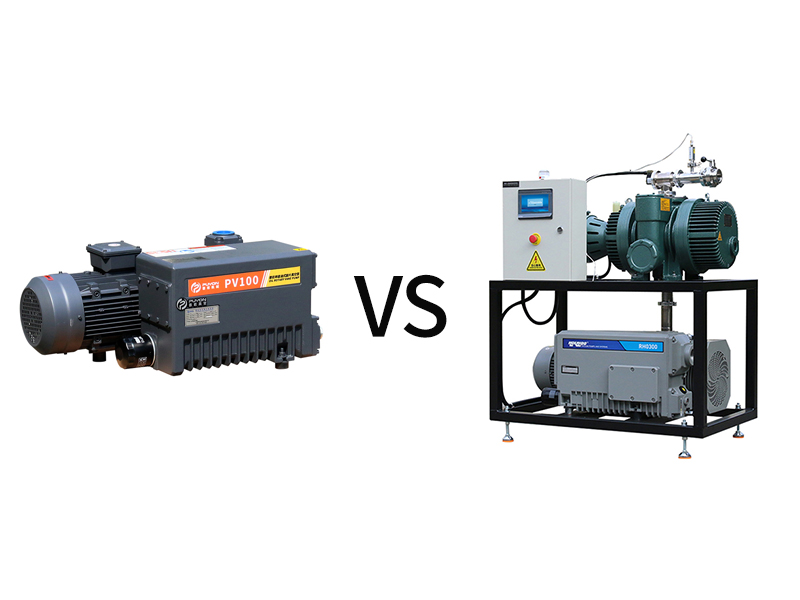
1. When a single pump is enough: scenarios where a system is unnecessary
If your operating conditions meet the following criteria, a well-matched single pump can do the job perfectly:
- Modest vacuum requirement: Applications such as vacuum packaging, blister forming, and vacuum handling typically operate above 10 kPa, where a single-stage rotary vane pump or water ring pump suffices.
- Stable and small gas load: A single device or a single vessel with a gas load within the rated pumping speed of the pump.
- Clean, dry gas: No corrosive components, large amounts of water vapor, or dust.
- Short or intermittent operation: No need for prolonged continuous high-load running.
In these scenarios, a single-pump unit is the most cost-effective choice due to its simple structure, low cost, and easy maintenance. However, once the operating conditions exceed the capabilities of a single pump, a system becomes necessary.
2. Five situations where a vacuum system is mandatory
Situation 1: The ultimate vacuum of a single pump is insufficient
Every type of vacuum pump has its inherent ultimate vacuum limit. A single-stage rotary vane pump typically reaches about 50–100 Pa, while a two-stage rotary vane pump can achieve 0.1 Pa. A water ring pump has an even lower limit, typically around 400 Pa.
If the process demands a deeper vacuum (e.g., 10⁻² Pa or even 10⁻³ Pa), a single pump simply cannot reach that level. In such cases, multi-stage series connection is required to progressively increase the vacuum level – for example, a system with a Roots pump as the main pump and a rotary vane pump as the backing pump can improve the ultimate pressure by an order of magnitude, reaching the 10⁻³ Pa range. For more extreme requirements, a three-stage series of mechanical pump + Roots pump + turbomolecular pump can achieve ultra-high vacuum.
Rule of thumb: If the process requires a vacuum deeper than a single pump's ultimate vacuum → you need a system.
Situation 2: The single pump has insufficient pumping speed at the target vacuum
This is a more subtle but more common problem. Many vacuum pumps experience a sharp drop in pumping speed near their ultimate vacuum. For instance, a rotary vane pump's pumping rate decreases continuously as it approaches its limit. However, the process may require maintaining a sufficient gas load at a relatively high vacuum level – for example, vacuum coating equipment operating at 10⁻² Pa still needs to quickly remove outgassing products.
In this case, adding a Roots pump in series upstream of the rotary vane pump (forming a Roots rotary vane vacuum system) compensates for the vane pump's reduced efficiency in the medium-to-high vacuum range. The Roots pump has excellent pumping efficiency in the 80–1 Pa pressure range, and combined with the rotary vane pump, it delivers both high vacuum and sufficient pumping speed.
Rule of thumb: If the process requires a large pumping capacity at a relatively high vacuum level → you need a system.
Situation 3: The main pump cannot start directly from atmospheric pressure
Some vacuum pumps, despite their excellent performance, have a limitation – they cannot start under atmospheric pressure. The Roots pump is a classic example. It offers high pumping speed and efficiency but cannot exhaust to atmosphere directly; it requires a backing pump to reduce the system pressure to its allowable starting pressure (typically below 1–10 kPa) before it can be started. Similarly, a turbomolecular pump requires a backing vacuum of below 1 Pa to start.
These pumps inherently require a backing pump – there is simply no option to use them as a single pump. Roots pumps must be paired with rotary vane pumps, screw pumps, or water ring pumps; turbomolecular pumps must be paired with rotary vane, scroll, or screw pumps.
Rule of thumb: If you have selected a Roots pump, turbomolecular pump, or any other pump that cannot exhaust directly to atmosphere → a system is mandatory.
Situation 4: The backing pump's exhaust capacity is insufficient
High-vacuum pumps (such as Roots pumps and turbomolecular pumps) require their outlet pressure to stay below a certain critical value for proper operation. If the backing pump's pumping speed is insufficient to promptly remove the gas discharged from the main pump, the main pump's outlet pressure rises, the compression ratio becomes too large, and the exhaust temperature increases. In severe cases, the Roots pump rotor may seize due to overheating.
The advantage of a multi-stage system is that as the system reaches a higher vacuum, the gas throughput of the main pump decreases significantly, so a smaller backing pump can maintain continuous pumping. This "large-and-small" combination ensures high-vacuum performance while avoiding oversizing the backing pump.
Rule of thumb: If the main pump's exhaust requires continuous support from a backing pump → you need a system (and the backing pump's speed must match that of the main pump).
Situation 5: Multiple devices need centralized vacuum supply
When multiple machines in a workshop require vacuum simultaneously, a common practice is to equip each with its own small pump. This "distributed" approach may seem simple, but it often leads to a large number of units, high total energy consumption, multiple failure points, and scattered maintenance.
A central vacuum system combines multiple pumps into a single system that supplies vacuum through a piping network. This enables higher energy efficiency – pumps can be started, stopped, or speed-adjusted based on real-time demand, typically saving over 50% energy compared to distributed setups. It also reduces workshop noise and facilitates centralized maintenance.
Rule of thumb: If multiple machines simultaneously use vacuum with fluctuating demand → you need a central vacuum system.
3. At a glance: single pump vs. system – how to choose?
| Decision factor | Single pump is sufficient | System is required |
|---|---|---|
| Ultimate vacuum | Rough vacuum (>100 Pa) | Medium to high vacuum (<100 Pa) |
| Pumping speed at target vacuum | Adequate | Single pump's speed drops sharply at target vacuum |
| Pump type | Pumps that can exhaust to atmosphere (rotary vane, water ring, etc.) | Pumps that cannot exhaust to atmosphere (Roots, turbomolecular, etc.) |
| System scale | Single device, small vessel | Large vessel, multiple devices needing centralized supply |
| Gas composition | Clean, dry | Contains corrosive/condensable gases (requires specific backing pump) |
Conclusion
When a single pump is sufficient, there is no need to force a system – that would be wasteful. But when a single pump cannot meet the requirements, pushing it too hard is risky. The essence of a vacuum system is to achieve a "1+1>2" performance breakthrough through the rational combination of different types of vacuum pumps. It overcomes the inherent limitations of a single pump in terms of ultimate vacuum, pumping speed in the medium-to-high vacuum range, and starting conditions. The selection logic is simple: first, determine what the process needs; second, check if a single pump can deliver; if not, go for a system.
It is far better to make the right decision at the selection stage than to discover after commissioning that the vacuum level is insufficient, pumping speed is inadequate, or failures occur frequently. The value of a vacuum system is never about how expensive it is to buy, but whether it works correctly for your application.