
What should you do if your vacuum pump electricity bill is too high? In the daily operations of manufacturing, electricity bills are becoming an increasing concern. Behind those high electricity bills, vacuum pumps are often the overlooked "energy guzzlers."
1. Why do vacuum pumps consume so much electricity?
Many factory vacuum pumps operate 24 hours a day, 7 days a week. A 15kW vacuum pump running continuously throughout the year can cost over 120,000 RMB in electricity alone. If a workshop has three, five, or even more pumps, this expense becomes quite staggering.
But that's not all. The biggest energy waste in traditional vacuum pumps comes from a phenomenon known as "overcapacity operation."
Most conventional vacuum pumps use fixed-frequency motors. Once started, they run at full rated speed regardless of whether the actual air demand is high or low. However, in real production, air demand is constantly changing – some machines are on standby, some are changing tools, and some are under light load conditions. The vacuum demand drops, but the pump continues to run at full speed, with excess air simply vented through overflow valves. This state of "having power but nowhere to use it" is the fundamental reason why so much electricity is wasted.
Statistics show that the mismatch between traditional fixed-frequency operation and dynamic load demand often results in 15%–30% energy waste. This is money that could have been saved.
2. Variable frequency technology: enabling vacuum pumps to supply energy on demand
To solve this problem, the key idea is quite simple: make the pump speed follow the actual demand – provide as much as needed, and no more.
This is the core logic behind variable frequency drive (VFD) technology. By adding a VFD, the system monitors the vacuum level in real time and automatically adjusts the motor speed based on actual air demand:
- When demand is high, the motor runs at full speed to ensure sufficient pumping capacity and vacuum level;
- When demand decreases, the motor automatically slows down, reducing pumping capacity and lowering energy consumption accordingly.
This "energy on demand" operating mode fundamentally eliminates the electricity waste caused by no-load operation in traditional fixed-frequency pumps.
3. How significant is the energy saving? – The cubic law tells you
The energy saving effect of variable frequency is far more remarkable than you might imagine. Behind this is an important physical law: the shaft power of a vacuum pump is proportional to the cube of the rotational speed (P∝n³).
For example: when the speed is reduced by 10%, energy consumption can be reduced by approximately 27%; a 20% speed reduction yields about 49% energy savings. For a vacuum pump rated at 75kW, if it only needs to run at 80% of its rated speed, the actual power consumption drops to 75×(0.8)³ ≈ 38.4kW – saving more than 700 kWh per day for a single unit.
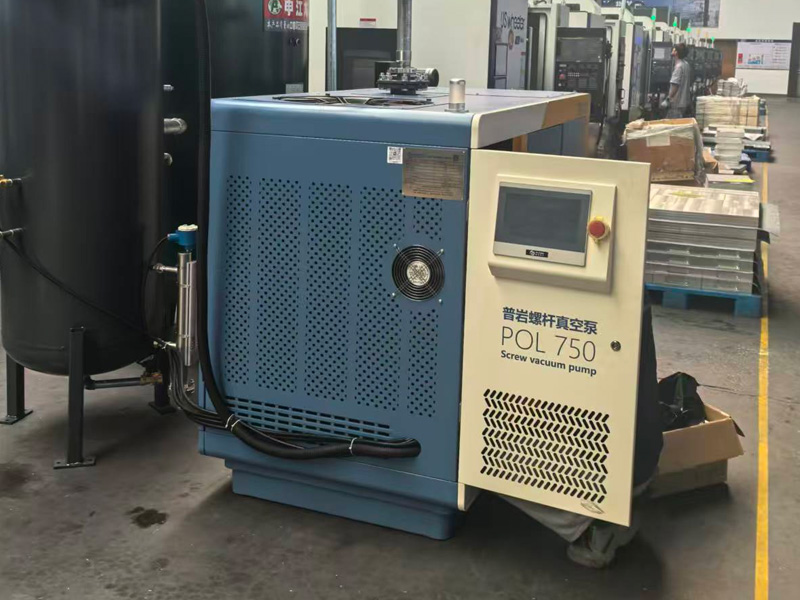
In practical applications, the oil-lubricated screw vacuum pump with variable frequency drive typically achieves energy savings of 30%–50% compared to traditional fixed-frequency technology. Based on 7,000 hours of annual operation and electricity at 0.75 RMB/kWh, a single pump can save the customer over 200,000 RMB per year in electricity costs. Under certain operating conditions, the energy saving rate can even reach 89%.
4. The oil-lubricated screw vacuum pump: more than just energy saving
In addition to remarkable energy savings, the variable frequency oil-lubricated screw vacuum pump also excels in the following aspects:
- Smoother operation: VFD soft starting avoids the large current surges of traditional motor start/stop, which is more grid-friendly and extends equipment life.
- Lower noise: Running at lower speeds most of the time, combined with noise reduction design, creates a quieter workshop environment.
- Less maintenance: No wear parts such as vanes, low maintenance frequency, significantly reduced maintenance costs.
- Waste heat recovery capability: Nearly 90% of the electrical energy in vacuum applications is converted into heat, and up to 75% of that can be captured and reused through energy recovery systems.
5. Which industries are already benefiting?
Variable frequency oil-lubricated screw vacuum pumps are widely used across a wide range of industries, including plastics, glass, can manufacturing, woodworking, packaging and printing, and food processing. In central vacuum systems, multiple pumps can be intelligently controlled to optimize load distribution, maximizing the overall energy efficiency of the entire pump station.
Conclusion
What should you do if your vacuum pump electricity bill is too high? The answer is not "use less," but "use smarter." The variable frequency oil-lubricated screw vacuum pump, through intelligent VFD technology, transforms the pump from "blind full-speed operation" to "energy on demand," genuinely reducing electricity costs while ensuring production needs are met. For manufacturing companies struggling with high electricity bills, this is perhaps a worthwhile energy-saving path to seriously consider.