
What types of dry vacuum pumps are available? In the field of vacuum technology, dry vacuum pumps (also known as oil-free vacuum pumps) are becoming the preferred choice for an increasing number of high-end manufacturing industries. What exactly are they? What types are available? What are the characteristics of each? This article provides a comprehensive overview for your reference.
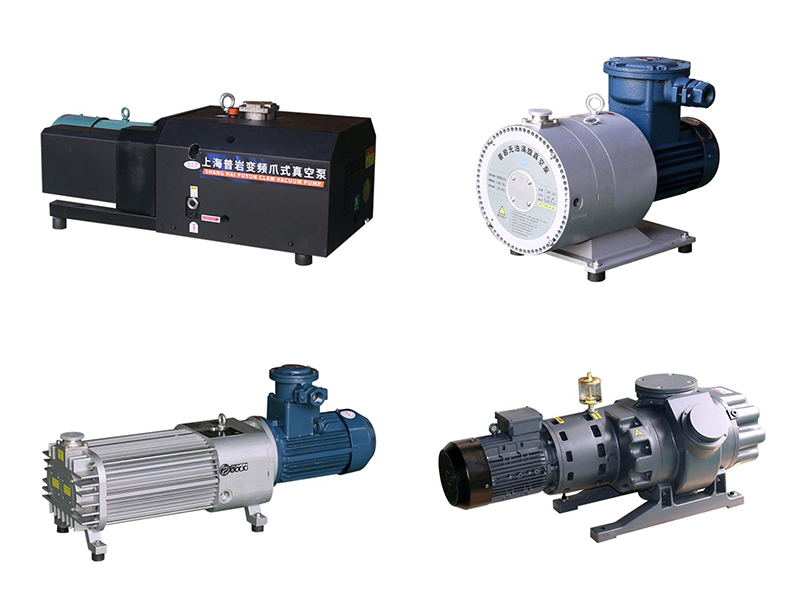
1. What is a dry vacuum pump?
A dry vacuum pump, as the name suggests, is a vacuum pump that does not require oil, water, or other working fluids in the pump chamber to participate in the gas compression process. Its exhaust port is directly open to the atmosphere, and it can continuously pump from atmospheric pressure and exhaust directly to the atmosphere.
Traditional oil-sealed vacuum pumps (such as rotary vane pumps) rely on pump oil for sealing, lubrication, and cooling. However, pump oil generates oil vapor at high temperatures, which can backstream into the evacuated chamber and cause contamination – unacceptable in fields with extremely high cleanliness requirements such as semiconductor manufacturing, pharmaceuticals, and food processing. Dry vacuum pumps were developed precisely to solve this "oil contamination" problem.
The core value of a dry vacuum pump lies in providing a truly "clean" vacuum environment – oil-free operation inside the pump chamber, exhaust gas free of oil vapor, and no hydrocarbon contamination of the evacuated vessel.
Today, dry vacuum pumps are widely used in semiconductor wafer manufacturing, lithium battery production, pharmaceutical freeze-drying, food packaging, laboratory analysis, and other fields with stringent cleanliness requirements for the vacuum environment. In semiconductor-related industries in developed countries, dry vacuum pumps have largely or completely replaced traditional oil-sealed mechanical pumps.
2. Main types of dry vacuum pumps
Dry vacuum pumps come in many varieties and can be classified by working principle into positive displacement and momentum transfer types. Positive displacement dry pumps achieve gas suction, compression, and discharge by changing the pump chamber volume. Common types include screw, claw, scroll, Roots, and reciprocating piston pumps. Below are the most common dry vacuum pumps currently on the market.
1. Dry screw vacuum pump
The dry screw vacuum pump is one of the most widely used and technologically mature types of dry pumps.
- Working principle: The pump chamber contains a pair of parallel, counter-rotating helical screw rotors driven by precision gears for synchronized reverse rotation. Gas is drawn in from the inlet, continuously conveyed and compressed along the axial direction, and finally discharged through the outlet. A small clearance is maintained between the screws and between the screws and the pump housing, ensuring no contact or friction during operation.
- Key features: Completely oil-free inside the pump chamber, providing clean vacuum; capable of handling gases with large amounts of water vapor and small amounts of dust; smooth operation with low noise; ultimate vacuum up to 1 Pa; variable-pitch screw designs are now available, offering up to 30% energy savings, higher ultimate vacuum, and lower exhaust temperature compared to constant-pitch designs.
- Applications: Semiconductor manufacturing, electronics industry, chemical pharmaceuticals (solvent recovery), photovoltaics, lithium batteries, and other fields with high cleanliness requirements.
2. Dry claw vacuum pump
The claw vacuum pump gets its name from the claw-like shape of its rotors.
- Working principle: The pump chamber contains two conjugate meshing claw-shaped rotors driven by a pair of synchronous high-precision gears for counter-rotation. Small clearances are maintained between the rotors and between the rotors and the pump housing, requiring no lubricant. The pump typically uses a multi-stage rotor series structure, with each stage located in a separate pump chamber for progressive gas compression.
- Key features: Completely oil-free and contaminant-free; no oil or liquid comes into contact with the flow path; ultimate vacuum up to -95 kPa gauge (i.e., absolute pressure of approximately 5 kPa, in the rough vacuum range); significant energy savings – can reduce energy consumption by up to 95% when replacing steam jet ejectors; capable of long-term continuous operation at higher pressures with low noise; more tolerant of small amounts of dust than screw pumps.
- Applications: Pharmaceuticals, chemicals, electronics, metallurgy, and other fields requiring clean vacuum.
3. Dry scroll vacuum pump
The scroll vacuum pump has a simple structure and reliable operation, making it a common dry pump in laboratories and light industry.
- Working principle: The pump core consists of a pair of interleaved spiral scrolls – one fixed (stationary scroll) and one orbiting (moving scroll) with an eccentric motion. Multiple enclosed crescent-shaped volume chambers are formed between the two scrolls. Gas is drawn in from the outer edge of the scrolls, progressively compressed toward the center, and finally discharged from the center.
- Key features: Only one moving part, making the structure extremely simple; bearings completely separated from the compression chamber, ensuring clean, dry pumping; can pump from atmosphere directly down to 3 Pa; lightweight and compact; better energy efficiency than some screw pumps.
- Applications: Laboratory analysis, medical equipment, semiconductor auxiliary processes, and other applications requiring high cleanliness and low flow rates. Not suitable for gases containing dust or liquid droplets.
4. Roots vacuum pump
The Roots vacuum pump (also known as a Roots blower) is a positive displacement rotary pump that also falls under the dry pump category.
- Working principle: The pump housing contains two figure-eight or tri-lobe rotors driven by precision gears for synchronized counter-rotation. Extremely small clearances are maintained between the rotors and between the rotors and the pump housing. Since there is no contact and no lubrication is required, the gas is not contaminated by oil during transport.
- Key features: A dry vacuum pump with oil-free rotor chamber operation, providing clean vacuum; high pumping speed with excellent pumping efficiency in the low to medium vacuum range; simple structure and long service life with minimal wear due to the absence of sliding components; provides clean vacuum and can be used from atmospheric pressure to ultimate pressure.
- Important prerequisite – cannot exhaust directly to atmosphere: Clearances between the Roots pump rotors and the pump housing create gas return paths. When started directly at atmospheric pressure, the pump cannot effectively discharge gas. The large pressure difference causes a sharp increase in motor load and rotor overheating due to thermal expansion, which can easily burn out the motor or cause rotor seizure. Therefore, a Roots pump can only be started after a backing pump has achieved a certain pre-vacuum level (typically 1–10 kPa).
- Combination with backing pumps: The Roots pump itself is a dry pump, and its ultimate vacuum depends on the backing pump used – the higher the ultimate vacuum of the backing pump, the higher the ultimate vacuum of the entire system. When the backing pump is a dry pump (such as a screw pump, claw pump, scroll pump, or diaphragm pump), the entire Roots system can be considered a dry vacuum system, meeting the requirements of clean vacuum applications.
- Applications: Semiconductor load lock chambers, rough pumping applications requiring high pumping speed, as an intermediate stage in large vacuum systems, etc.
5. Dry reciprocating piston vacuum pump
The reciprocating vacuum pump (also known as a piston vacuum pump) is one of the most traditional types of dry vacuum pumps.
- Working principle: A piston in the cylinder performs a reciprocating motion to draw in and discharge gas. The reciprocating motion causes cyclic volume changes in the cylinder, enabling gas suction, compression, and discharge.
- Key features: Not sensitive to water vapor; robust structure and easy operation; relatively low ultimate vacuum.
- Applications: Rough pumping applications with low vacuum requirements, and applications requiring high tolerance to water vapor.
6. Dry diaphragm vacuum pump
The diaphragm vacuum pump is a small dry pump widely used in laboratory and medical fields.
- Working principle: The motor drives the diaphragm through an eccentric shaft and connecting rod to perform a reciprocating motion. The up-and-down movement of the diaphragm changes the diaphragm chamber volume, and with the cooperation of check valves, completes gas suction and discharge.
- Key features: Completely oil-free; no oil comes into contact with the gas path; compact and lightweight; ultimate pressure comparable to oil-sealed vacuum pumps; can be used as a backing pump for turbomolecular pumps.
- Applications: Laboratory vacuum filtration, vacuum concentration, degassing and defoaming, medical suction, analytical instruments, etc.
3. How to choose the right dry vacuum pump?
Different types of dry vacuum pumps each have their pros and cons. When selecting, consider the following factors based on your specific operating conditions:
| Type | Ultimate vacuum | Pumping speed characteristics | Suitable applications | Main limitations |
|---|---|---|---|---|
| Screw | High (~1 Pa) | Broad range | High flow, media-resistant, handles water vapor/dust | Higher cost |
| Claw | Moderate (~-95 kPa gauge) | Medium | Clean oil-free, handles small amounts of dust | Relatively low ultimate vacuum |
| Scroll | High (~3 Pa) | Small | Ultra-clean, low flow | Not suitable for gases with dust or liquid droplets |
| Roots | Depends on backing pump | Large | High pumping speed, rough pumping | Cannot exhaust directly to atmosphere; requires backing pump |
| Reciprocating piston | Low | Medium | Water vapor tolerant, rough pumping | Low ultimate vacuum |
| Diaphragm | Medium | Small | Laboratory, medical | Small pumping speed |
Core selection guidelines:
- High flow, media-resistant, handles water vapor/dust → Dry screw vacuum pump
- General economical option, handles small amounts of dust → Claw vacuum pump
- Ultra-clean, high vacuum, low flow → Scroll vacuum pump
- High pumping speed, medium-to-rough vacuum, with backing pump available → Roots vacuum pump (ultimate vacuum depends on backing pump performance)
Conclusion
The dry vacuum pump family is large – screw, claw, scroll, Roots, reciprocating piston, diaphragm, and more. Their common characteristics are oil-free operation, cleanliness, and environmental friendliness, providing ideal vacuum solutions for industries such as semiconductors, pharmaceuticals, chemicals, and food processing where cleanliness is strictly required.
It is particularly important to note that while the Roots vacuum pump itself is a dry pump, it cannot start directly under atmospheric pressure and must be paired with a backing pump – if the backing pump is a dry pump, the entire system constitutes a dry vacuum system, with its ultimate vacuum determined by the backing pump's performance.
As manufacturing industry demands for clean production and product quality continue to rise, dry vacuum pumps are moving from being a "premium option" to a "standard configuration." Understanding the characteristics and applicable boundaries of different types of dry pumps is the first step toward correct selection and rational investment.