
Ultimate partial pressure vs. ultimate total pressure: two key parameters you must know for vacuum pump selection. In the process of selecting a vacuum pump, many people focus on a core parameter – ultimate vacuum (or ultimate pressure). But have you ever noticed that on the same vacuum pump datasheet, two different values are sometimes listed: ultimate total pressure and ultimate partial pressure? What is the difference between them? And which one should you actually look at when selecting a pump? This article will start from the basic concepts and thoroughly clarify these two easily confused parameters.
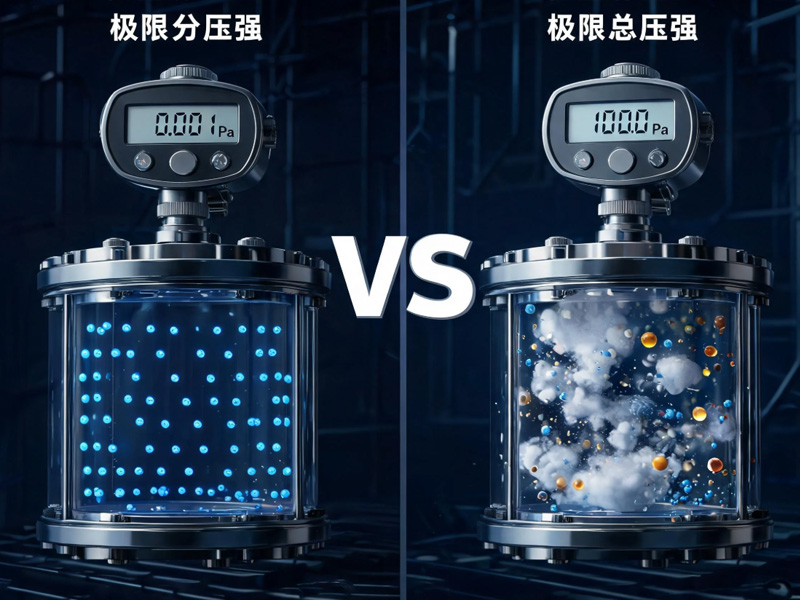
1. First, understand two basic concepts: total pressure and partial pressure
Before we get to the "ultimate" part, we need to understand the basic concepts of "total pressure" and "partial pressure."
Total pressure refers to the sum of the pressures exerted by all gas molecules in a vacuum system. In simple terms, it is the sum of the pressures of all gases present in the system (nitrogen, oxygen, water vapor, oil vapor, etc.).
Partial pressure refers to the pressure exerted by a specific type of gas in a gas mixture. For example, the partial pressure of nitrogen, the partial pressure of water vapor, and the partial pressure of oil vapor in the vacuum system.
Think of it this way: total pressure is like the total weight of a pot of soup, while partial pressures are the individual weights of salt, sugar, and MSG in the soup. Knowing the total weight doesn't tell you how much of each ingredient is present – this distinction is exactly the key to understanding ultimate total pressure and ultimate partial pressure.
2. What is ultimate total pressure?
Ultimate total pressure is the lowest stable total pressure that a vacuum pump can achieve after prolonged continuous pumping under standard test conditions. It reflects the sum of the pressures of all gaseous substances (including air, water vapor, oil vapor, etc.) at the pump inlet.
Ultimate total pressure is typically measured with a thermal conductivity vacuum gauge (e.g., Pirani gauge) or a hot cathode ionization gauge. These instruments respond to all gases, so the measured value includes the contribution of all gases in the system.
Internationally, many vacuum pump manufacturers place greater emphasis on the test value of total pressure (full pressure). This is because ultimate total pressure more closely reflects the pump's overall performance in actual use – it indicates the pump's ability to remove "everything" (including pump oil vapor, water vapor, etc.).
3. What is ultimate partial pressure?
Ultimate partial pressure is the partial pressure of a specific gas (usually air or nitrogen) that a vacuum pump can achieve under standard test conditions.
The measurement method for ultimate partial pressure is different: it is typically measured with a mercury compression vacuum gauge (McLeod gauge). One characteristic of the McLeod gauge is that it measures the partial pressure of non-condensable gases (such as air and nitrogen) almost exclusively, and responds very little to condensable gases (such as water vapor and oil vapor). Therefore, ultimate partial pressure represents, to some extent, the pump's ability to remove permanent gases.
In current vacuum pump performance standards, unless otherwise specified as total pressure, the ultimate pressure value is by default the partial pressure. This is why on many pump nameplates you see a smaller number (e.g., 6×10⁻² Pa) rather than a larger one – because that number is usually the partial pressure.
4. Ultimate total pressure vs. ultimate partial pressure: the core difference
The essential difference between the two can be summarized in one sentence: Ultimate partial pressure measures only "air" as one component, while ultimate total pressure measures "everything."
| Comparison dimension | Ultimate total pressure | Ultimate partial pressure |
|---|---|---|
| Measurement target | Sum of pressures of all gases in the system | Pressure of a specific gas (usually air/nitrogen) in the system |
| Measuring instrument | Thermal conductivity gauge, ionization gauge | Mercury compression vacuum gauge (McLeod gauge) |
| Includes oil vapor/water vapor? | Yes | No (only measures non-condensable gases) |
| Numerical value | Typically larger | Typically smaller |
| Capability reflected | Comprehensive pumping capability (including oil vapor, etc.) | Ability to remove permanent gases |
There is also an important quality criterion between the two: The difference between ultimate total pressure and ultimate partial pressure should not exceed one order of magnitude. If the difference is too large – for example, if ultimate total pressure is much higher than ultimate partial pressure – it indicates that the vacuum pump oil contains a high proportion of volatile components (such as low-boiling fractions), and the oil quality is poor. This also explains why high-quality vacuum pump oil must have a sufficiently low saturated vapor pressure.
5. Vacuum pump selection: which parameter should you look at?
Now that you understand the difference between these two concepts, which one should you base your selection on? The answer is: it depends on your process requirements.
Scenario 1: Process is not sensitive to oil vapor – total pressure is more practical
If your process is not very sensitive to "impurities" such as oil vapor and water vapor in the vacuum environment (e.g., general vacuum packaging, vacuum forming, vacuum handling), then ultimate total pressure is a more practical reference indicator. It tells you how far the pump can actually remove "everything" in real operation.
Scenario 2: Process is highly sensitive to oil vapor – partial pressure is mandatory
If your process is extremely sensitive to oil vapor – such as high-end applications like vacuum coating, semiconductor manufacturing, electronic devices, and mass spectrometry – then looking at ultimate total pressure alone is not enough. Because the total pressure may come mainly from pump oil vapor, while the true "effective vacuum" (air partial pressure) may not be ideal. In this case, you must focus on ultimate partial pressure, which represents the pump's true ability to remove permanent gases like air.
Scenario 3: Evaluating oil quality – both parameters are needed
When assessing the quality of vacuum pump oil, both parameters should be considered together. As mentioned above, the larger the difference between ultimate total pressure and ultimate partial pressure, the more volatile components are present in the oil, and the poorer the oil quality. Therefore, high-quality vacuum pump oil should keep the difference between the two values within one order of magnitude.
6. Other considerations for pump selection
Besides understanding total pressure and partial pressure, here are some additional points to keep in mind when selecting a vacuum pump:
- Leave a margin for working pressure: The ultimate pressure of the pump should be one-half to one order of magnitude higher (i.e., lower numerical value) than the vacuum level required by the process. For example, if the process requires 100 Pa, you should consider a pump with a rating of 50 Pa or even 10 Pa.
- Check gas composition: Does the pumped gas contain water vapor, corrosive gases, or dust? All of these affect the choice of pump type.
- Distinguish absolute pressure from gauge pressure: Absolute pressure is referenced to "theoretical vacuum (0 Pa)," while gauge pressure is referenced to "atmospheric pressure." The numerical values are completely different, so be sure to confirm which one is being used.
- Different pump types suit different pressure ranges: For absolute pressures above 3300 Pa, a water ring vacuum pump is preferred; below 3300 Pa, a rotary vane pump or a higher-vacuum pump is needed.
Conclusion
Ultimate total pressure and ultimate partial pressure – although they differ by only a few words – represent completely different physical meanings and engineering values in vacuum technology. Total pressure reflects the pump's comprehensive ability to remove "everything," while partial pressure reflects the pump's true capability to remove "permanent gases like air."
When selecting a vacuum pump, understanding the difference between these two parameters enables you to make the right choice based on your actual process needs – whether total pressure alone is sufficient, or whether partial pressure must be strictly considered. Choose correctly, and your equipment will perform efficiently; choose incorrectly, and you may face substandard performance or even complete process failure. We hope this explanation helps you avoid costly mistakes in your future selections.