
What is the cost of choosing the wrong vacuum pump? – An analysis of failures of two-stage rotary vane pumps and screw pumps under low vacuum conditions. In vacuum equipment selection, one of the most common mistakes is using a high-vacuum pump for low-vacuum applications. Many users believe that "overcapacity is better than undercapacity," or due to budget constraints, they use two-stage rotary vane vacuum pumps or screw vacuum pumps for extended periods in low vacuum environments (e.g., several kPa or even near atmospheric pressure). This practice of "overkill" not only fails to deliver performance advantages but also triggers a series of serious equipment failures and hidden costs.
1. Two-stage rotary vane pumps: "Chronic suicide" under low vacuum conditions
The core design objective of a two-stage rotary vane pump is to achieve a high ultimate vacuum (typically down to 10⁻¹ Pa or even lower). Its two-stage structure means that gas must pass through two working chambers sequentially to be compressed, placing stringent demands on the lubrication system.
When a two-stage rotary vane pump operates in low vacuum for a long time, the following failures gradually appear:
1.1 Lubrication failure – "oil starvation" and seizure of the low-stage rotor
This is the most typical and fatal failure of two-stage rotary vane pumps under low vacuum conditions. The two-stage pump has two pump chambers: the high-stage rotor and the low-stage rotor. Under normal high-vacuum operation, the amount of gas entering the pump chamber is relatively small, and the pump oil can return to the low-stage rotor chamber through dedicated oil passages, maintaining adequate lubrication.
However, under low vacuum conditions, a large amount of gas continuously rushes into the pump chamber. The valve plates remain open for extended periods, preventing the pump oil from returning normally to the low-stage rotor. The low-stage rotor chamber suffers from severe oil starvation, leading to dry friction between the vanes and the pump wall, ultimately causing the low-stage rotor to seize. If the pump seizes during operation and the operator is not present, the motor can easily burn out.
1.2 Smoke emission, oil spray, and oil degradation
Under low vacuum, a large volume of air is continuously drawn into the pump and mixes violently with the pump oil. The air mixed into the oil carries a large amount of oil mist when discharged, resulting in smoke and oil spray. More seriously, if the pumped gas contains water vapor, the pump oil rapidly emulsifies and deteriorates. In one user case, after emulsification, the oil "looked like milk tea," requiring an oil change every half month, with the oil change cost even exceeding the electricity bill.
1.3 Abnormal wear of vanes and pump wall
The direct consequence of insufficient lubrication is increased mechanical wear. The vanes and pump wall rub directly against each other without the protection of an oil film, not only generating significant noise and abnormal sounds but also causing irreversible damage such as scoring of the pump chamber and vane fracture. Over time, the ultimate vacuum of the pump continuously declines, and the pumping cycle becomes shorter and shorter.
2. Screw vacuum pumps: "Premature failure" under low vacuum conditions
Screw vacuum pumps are also unsuitable for long-term low vacuum operation. Whether oil-lubricated or dry screw pumps, the meshing clearance between the screw rotors is extremely small, typically only 0.1–0.3 mm. This precision structure faces significant challenges under low vacuum, high-flow conditions.
2.1 Rotor seizure due to thermal expansion
Under low vacuum conditions, a screw pump must continuously handle large volumes of gas, causing the compression ratio and exhaust temperature to rise sharply. The rotors undergo thermal expansion at high temperatures. When the expansion exceeds the design clearance, the male and female rotors come into direct metal-to-metal contact, leading to a vicious cycle of friction → temperature rise → material softening → localized welding, ultimately causing rotor seizure (locking). This is no exaggeration – the temperature rise and thermal deformation of rotors caused by backflow of exhaust gas are indeed one of the main triggers for screw pump seizure.
2.2 Motor overload and frequent tripping
Low vacuum conditions mean the pump operates under high load for extended periods. When a screw pump runs at its ultimate pressure ratio for a long time, the motor current remains continuously high, easily triggering overload protection and tripping. More dangerously, if the pump suddenly stops while the system is under vacuum, the internal pressure remains low while the external pressure is atmospheric, creating a large pressure difference across the pump. Restarting becomes very difficult, and forced starting may cause motor overcurrent, a sharp rise in pump body temperature, or even pump body rupture.
2.3 Seal failure and increased clearances
Prolonged operation under low vacuum and high temperature accelerates bearing wear in the screw pump, leading to increased axial movement and radial displacement of the rotors. As the clearances between the rotors and the housing, and between the rotors and end faces, increase, internal leakage rises sharply, and effective pumping speed drops significantly. Even if the pump is later returned to high vacuum conditions, its ultimate vacuum has permanently degraded.
2.4 Abnormal vibration and metal friction
After rotor imbalance, bearing wear, or ingestion of foreign objects, the screw pump will exhibit obvious abnormal vibration and metallic friction sounds during operation. If rotor rubbing has already occurred, the pump often needs to be returned to the factory for inspection or even rotor replacement, with extremely high repair costs.
3. Cost breakdown: The hidden costs of choosing the wrong pump far exceed expectations
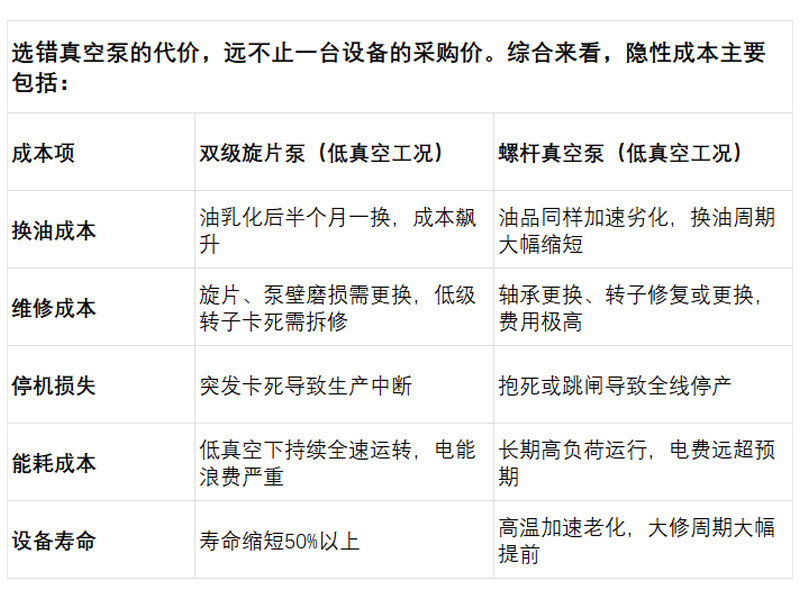
The cost of choosing the wrong vacuum pump goes far beyond the purchase price of the equipment. Overall, the hidden costs mainly include:
| Cost item | Two-stage rotary vane pump (low vacuum) | Screw vacuum pump (low vacuum) |
|---|---|---|
| Oil change cost | Oil changes every two weeks after emulsification; cost skyrockets | Oil also degrades faster; oil change intervals shortened significantly |
| Maintenance cost | Vanes and pump wall wear require replacement; low-stage rotor seizure requires disassembly and repair | Bearing replacement, rotor repair or replacement – extremely costly |
| Downtime loss | Sudden seizure causes production interruption | Locking or tripping leads to total production line stoppage |
| Energy cost | Continuous full-speed operation under low vacuum, severe power waste | Long-term high-load operation, electricity costs far exceeding expectations |
| Equipment life | Service life shortened by over 50% | High temperature accelerates aging; major overhaul cycle arrives much earlier |
An experienced engineer once summed it up: "Save 50,000 on the pump, but pay 80,000 more in electricity and 30,000 more in maintenance each year, plus frequent production stoppages." That is the true picture of choosing the wrong pump.
4. The correct selection logic
The advantage of a two-stage rotary vane pump lies in its high ultimate vacuum, making it suitable for applications such as vacuum coating, electronic devices, and laboratory instruments that require 10⁻¹ Pa or even higher vacuum levels. It is ideal for "clean, dry, low-flow" pumping environments.
The advantage of a screw vacuum pump lies in its high pumping speed and low or oil-free contamination, making it suitable for semiconductor, pharmaceutical, photovoltaic, and other industries with strict cleanliness requirements. However, it is equally unsuitable for long-term operation under low vacuum and high-flow conditions.
If your process truly requires long-term operation in a low vacuum environment (e.g., several kPa), the correct approach is to choose a pump specifically designed for low vacuum – such as a single-stage rotary vane pump, a water ring pump, or a Roots pump system – rather than "downgrading" a high-vacuum pump.
Vacuum pump selection is never a simple matter of looking at parameters; it is a systematic engineering process that combines process, operating conditions, and costs. Investing more effort at the selection stage far outweighs the costs of frequent repairs, production stoppages, and equipment replacement after commissioning.