
What is a claw vacuum pump? In the dry vacuum pump family, the claw vacuum pump (also known as the claw-type dry vacuum pump or claw pump) is a technically mature and widely used positive displacement oil-free vacuum pump. With its unique advantages of completely oil-free operation and the ability to handle gases containing particles and corrosive media, it plays an increasingly important role in many industries such as semiconductors, chemicals, pharmaceuticals, and food processing.
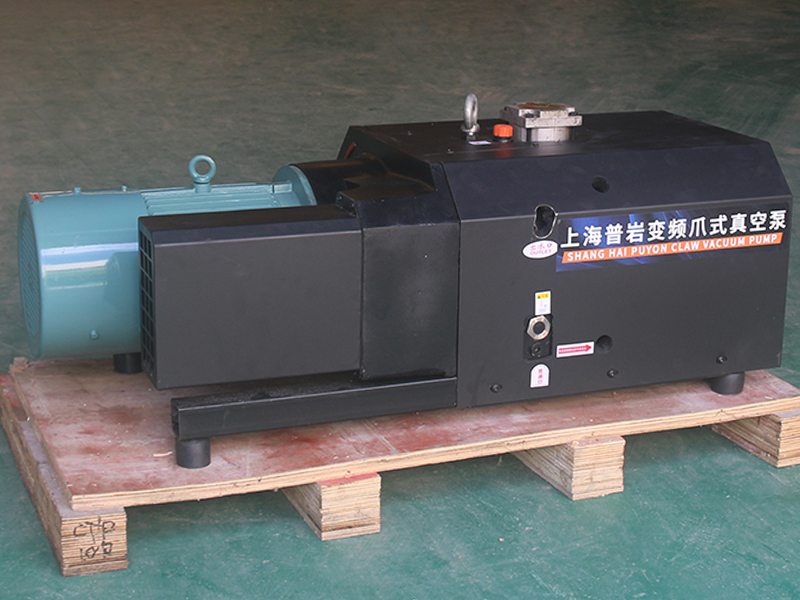
1. What is a claw vacuum pump?
The claw vacuum pump gets its name from its core component – the rotors that are shaped like "claws". It is a positive displacement dry vacuum pump that uses claw-type rotor structures, achieving gas compression through multi-stage claw rotors connected in series or in combination with Roots rotors.
The most fundamental difference between it and oil-lubricated vacuum pumps is that absolutely no oil, water, or other working fluids are used inside the pump chamber. Micron-level clearances are maintained between the rotors and between the rotors and the pump housing, ensuring no contact and no friction during operation. This "non-contact" design enables the claw vacuum pump to provide a truly clean, oil-free vacuum environment.
2. Working principle
The working principle of a claw vacuum pump is based on the positive displacement principle – compressing or extracting gases by changing the volume of the working chambers.
Inside the pump housing, a pair of conjugate meshing claw-shaped rotors are driven by a pair of precision synchronous gears for non-contact counter-rotation. A complete pumping cycle consists of five processes: suction, isochoric transfer, compression, exhaust, and mixing.
Specifically:
- Suction phase: When the rotors rotate to a specific position, the inlet channel opens, and the suction chamber volume gradually increases, creating a negative pressure to draw gas in.
- Compression phase: As the rotors continue to rotate, the suction chamber transitions to a compression chamber, and the gas is progressively compressed.
- Exhaust phase: When the gas is compressed to a certain pressure, the exhaust channel opens and the gas is discharged.
- Mixing phase: The suction and exhaust chambers briefly communicate, and the gas in the chambers mixes.
Each full rotation of the rotors completes one complete suction and exhaust cycle. The gas undergoes internal pre-compression in the compression chamber before being discharged, resulting in higher energy efficiency compared to traditional rotary lobe blowers that do not employ internal compression.
Claw vacuum pumps can be classified into vertical and horizontal types based on rotor arrangement; and into spiral, reverse-claw, and spiral-reverse-claw types based on rotor working principles. Vertical claw vacuum pumps typically have 3 or 4 stages of compression to achieve higher vacuum levels, while horizontal claw vacuum pumps are mostly single-stage and used for rough vacuum applications.
3. Core characteristics
Advantages:
- Completely oil-free, clean and contaminant-free: This is the core value of the claw vacuum pump. Oil-free operation inside the pump chamber means the exhaust gas contains no oil vapor, and the evacuated vessel is not contaminated by hydrocarbons. The process flow media do not come into contact with any oil or other liquid lubricants inside the pump.
- Capable of handling gases with particles and corrosive media: This is a significant advantage that distinguishes claw vacuum pumps from many other dry pumps. Due to the non-contact rotor operation, they can handle gases containing micro-particles or corrosive media.
- Significant energy savings: Claw vacuum pumps employ internal compression, offering higher energy efficiency. In practical applications, compared to traditional steam jet ejectors, they can achieve energy savings of over 95%; compared to traditional vacuum technologies, they can save more than 60% energy at the same pumping speed.
- Low maintenance cost: Since there is no substantial contact between rotors or between rotors and the pump housing, there is virtually no mechanical wear. Some models have maintenance intervals of up to 20,000 hours.
- Can start directly from atmospheric pressure: Claw vacuum pumps can start directly under atmospheric pressure without the need for pre-evacuation, making operation convenient.
- Low operating noise: With noise reduction designs, some products are among the quietest claw pumps on the market.
Limitations:
- Complex multi-stage structure: To achieve higher vacuum levels, claw pumps typically require 3–4 stages in series. The stages are separated by partitions, resulting in long and curved gas passages.
- High assembly and maintenance requirements: Multi-stage structures mean multiple clearances (between rotors, between rotors and end covers, partitions, and the pump housing) must be controlled, making assembly and maintenance relatively complex.
- Lower tolerance for ultra-fine dust compared to screw pumps.
- Relatively smaller pumping speeds.
4. Main technical parameters
The ultimate vacuum and pumping speed of a claw vacuum pump depend on the number of stages:
| Number of stages | Ultimate vacuum | Description |
|---|---|---|
| Two-stage pump | Approx. 500 Pa | Suitable for rough vacuum applications |
| Three-stage pump | Approx. 50 Pa | Medium vacuum requirements |
| Four-stage pump | Up to 1 Pa | High vacuum requirements |
Pumping speeds range from tens to 1,140 m³/h. Some models support variable frequency drives, allowing precise speed control for better performance and energy savings.
5. Application fields
Claw vacuum pumps have an extremely wide range of applications, covering almost all industries that require clean vacuum:
- Semiconductor manufacturing: Etching, wafer handling, and other processes
- Chemical and petrochemical: Crystallization, distillation, rectification, sublimation, polymerization, vacuum evaporation, vacuum drying, negative pressure concentration, oil and gas recovery, adsorption/desorption, etc.
- Pharmaceutical industry: Pharmaceutical vacuum drying, sterile packaging
- Food processing: Vacuum packaging, thermoforming, vacuum conveying
- Medical technology: Medical suction, central vacuum systems in hospitals
- Environmental protection and wastewater treatment: Water and sewage treatment
- Metallurgy: Vacuum melting, vacuum sintering
- CNC and automation: CNC engraving, pneumatic conveying, pick-and-place
- New energy: Lithium battery manufacturing
- Aerospace and coating: Aerospace coating
6. Selection considerations
When selecting a claw vacuum pump, it is recommended to pay attention to the following points:
- Vacuum requirement: For rough vacuum applications, a two-stage pump is sufficient; for higher vacuum (e.g., 1 Pa level), a four-stage pump is required.
- Gas composition: Claw pumps excel at handling gases containing particles, corrosive, or condensable components. However, if the gas contains large amounts of organic solvents, the multiple end faces of a multi-stage claw pump may face increased liquid load risks.
- Maintenance convenience: The multi-stage structure makes assembly and disassembly relatively complex, so consider the ease of maintenance for later stages.
- Consider combined use: Claw vacuum pumps are often paired with Roots pumps in a system to achieve higher pumping speed and deeper vacuum.
Conclusion
The claw vacuum pump is an important member of the dry vacuum pump family. With its unique "claw-shaped rotor, non-contact operation" design, it achieves completely oil-free, clean, and environmentally friendly vacuum acquisition. Moreover, its outstanding ability to handle gases containing particles and corrosive media gives it a solid position in many industries such as semiconductors, chemicals, pharmaceuticals, and food processing.
Although the multi-stage structure brings complexity in assembly and maintenance, its advantages of significant energy savings, long maintenance intervals, and reliable operation make it a preferred solution for many medium-to-high vacuum clean applications. Understanding the working principle, performance boundaries, and suitable applications of the claw vacuum pump is the first step toward correct selection and rational investment.