
What is a Roots booster vacuum pump? In the field of vacuum technology, the Roots booster vacuum pump (also known as the Roots vacuum pump or mechanical booster pump) is an extremely important vacuum acquisition device. It was first developed in Germany in 1944 to meet the need for high pumping speeds in the 10–1000 Pa pressure range for vacuum melting systems. Today, it has become one of the core equipment items for many medium and high vacuum applications, including semiconductors, chemicals, metallurgy, and vacuum coating.
So, what exactly is a Roots booster vacuum pump? How is it different from ordinary vacuum pumps? And how does it work? This article provides a comprehensive overview for your reference.
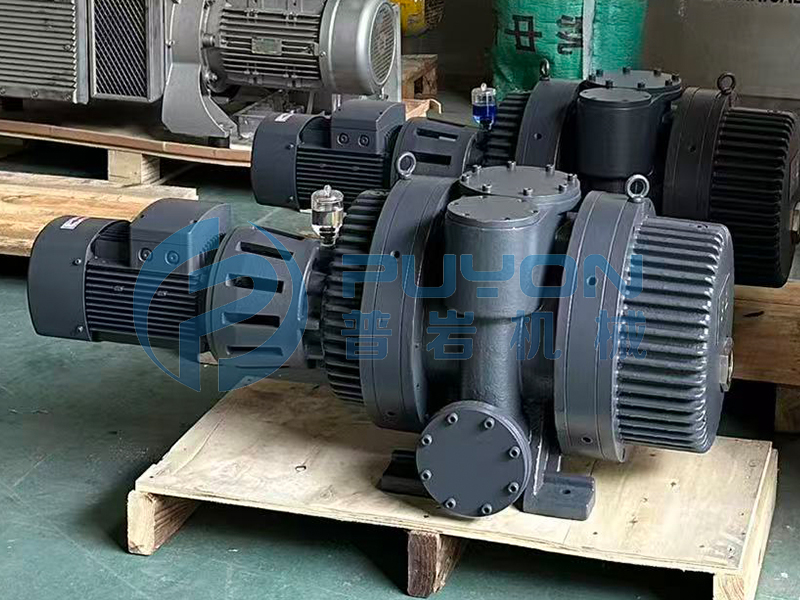
1. What is a Roots booster vacuum pump?
A Roots booster vacuum pump, referred to as a Roots pump for short, is a rotary positive displacement vacuum pump whose structure evolved from the Roots blower. It uses two figure-eight (or tri-lobe) rotors inside the pump housing that rotate synchronously in opposite directions to achieve gas suction, compression, and discharge.
The Roots booster vacuum pump has two core defining characteristics:
First, it is essentially a dry pump. Small clearances (typically 0.1–0.3 mm) are maintained between the rotors and between the rotors and the pump housing wall, with no contact during operation. Therefore, no oil or water is required as a sealing medium inside the pump chamber. The discharged gas is clean and oil-free, causing minimal contamination of the vacuum system.
Second, it is a "booster" pump rather than a stand-alone vacuum pump. The unique feature of the Roots booster vacuum pump is that it cannot discharge gas directly to the atmosphere on its own. It must be used in series with a backing vacuum pump (such as a rotary vane pump, screw pump, or water ring pump). The pumped gas is ultimately discharged to the atmosphere through the backing pump. Because it is connected in series upstream of the backing pump to "boost" the pumping speed, it is called a mechanical booster pump.
2. Working principle
The working principle of a Roots booster vacuum pump can be understood as follows:
Inside the pump housing, a pair of figure-eight rotors are driven by precision synchronous gears to rotate at high speed in opposite directions. Very small clearances are maintained between the rotors and between the rotors and the pump housing, with no contact.
As the rotors rotate, gas entering from the inlet is "trapped" in the enclosed space between the rotors and the pump housing. As the rotors continue to turn, this gas is "pushed" from the inlet side to the exhaust side by the rotors, and then discharged to the atmosphere through the downstream backing pump.
The key point is that the Roots pump does not perform "internal compression" of the gas inside the pump chamber, which means the gas volume is not reduced within the pump chamber. Its function is more like "transporting" the gas to the inlet of the backing pump, allowing the backing pump to operate at a higher inlet pressure, thereby significantly increasing the overall pumping speed of the system.
Simply put: the Roots booster vacuum pump solves not the problem of "how deep a vacuum can be achieved," but rather "how quickly the vacuum is achieved." In the pressure range where the pumping speed of the backing pump begins to decline (e.g., 1000 Pa to 1 Pa), the Roots pump can significantly boost the pumping speed, compensating for the insufficient pumping speed of the backing pump in this range.
3. Core characteristics
The widespread use of Roots booster vacuum pumps is due to a series of unique advantages:
- High pumping speed over a wide pressure range Roots pumps maintain high pumping speeds over a broad pressure range from 1000 Pa to 1 Pa. They are particularly effective at compensating for the sharp drop in pumping speed that backing pumps like rotary vane pumps and water ring pumps experience in the medium vacuum range. When a Roots pump is combined with a backing pump, the ultimate pressure of the entire system can be reduced by approximately one order of magnitude compared to using the backing pump alone.
- Clean and oil-free No lubricating oil is required inside the pump chamber, and the rotors are sealed by precision clearances. Therefore, the discharged gas contains no oil vapor and does not contaminate the vacuum system. This is particularly important for industries with extremely high cleanliness requirements, such as semiconductors and vacuum coating.
- Can handle condensable vapors Because there is no internal compression and no exhaust valves inside the Roots pump, it is insensitive to condensable gases such as water vapor and organic solvent vapors in the pumped gas, making it suitable for handling wet gases and condensable gases.
- Low vibration and low noise The rotors have good geometric symmetry and excellent dynamic balance, resulting in smooth operation and low vibration.
- Fast start-up Roots pumps can reach ultimate vacuum in a very short time, making them suitable for processes requiring rapid evacuation.
4. Must be used with a backing pump – a critical prerequisite
A Roots booster vacuum pump cannot operate independently – this is one of its fundamental characteristics. The reasons are:
- The Roots pump has no internal compression capability and cannot compress gas directly to atmospheric pressure for discharge;
- When started directly at atmospheric pressure, the pressure difference across the rotors is too large, causing motor overload, rotor overheating and expansion, and in severe cases, seizure or motor burnout.
Therefore, the use of a Roots pump must follow a strict start-up sequence: start the backing pump first, and only start the Roots pump after the system pressure drops to the Roots pump's allowable starting pressure (typically 1–10 kPa).
The choice of backing pump determines the final ultimate vacuum of the entire system. Depending on the type of backing pump, the combination of a Roots pump and a backing pump forms Roots vacuum systems with different performance characteristics, suited to different operating conditions:
| System type | Backing pump type | Characteristics | Typical applications |
|---|---|---|---|
| Roots rotary vane vacuum system | Rotary vane pump (oil-sealed) | High ultimate vacuum, moderate cost, good cleanliness | General medium-high vacuum applications such as vacuum coating, vacuum heat treatment, vacuum impregnation, etc. |
| Roots screw vacuum system | Dry screw pump | Clean, oil-free, ultimate vacuum up to 0.1 Pa, tolerant to moisture and small amounts of dust | Semiconductor, pharmaceutical, chemical, electronics, new energy, and other applications requiring clean vacuum |
| Roots water ring vacuum system | Water ring pump | Moisture-tolerant, dust-tolerant, ultimate vacuum approx. -100 kPa (gauge) | Rough vacuum applications with moisture and wet gases, such as chemical and pharmaceutical processes |
The pumping speed of a Roots pump is typically 2 to 8 times that of the backing pump. The specific combination should be matched according to process requirements to achieve optimal performance.
5. Application fields
Roots booster vacuum pumps have an extremely wide range of applications, covering almost all industrial fields requiring medium to high vacuum:
- Vacuum metallurgy: vacuum degassing, vacuum melting, molten steel vacuum treatment
- Vacuum coating: optical coating, semiconductor coating, large-area glass coating
- Semiconductor manufacturing: etching, chemical vapor deposition (CVD), and other processes
- Chemical and pharmaceutical: vacuum distillation, vacuum drying, vacuum crystallization, vacuum polymerization (often with Roots water ring systems)
- Food industry: vacuum packaging, vacuum freeze drying
- Aerospace and research: space simulation, low-density wind tunnel experiments
- Power and electrical engineering: vacuum impregnation, transformer drying (often with Roots rotary vane systems)
6. Selection and usage considerations
When selecting and using a Roots booster vacuum pump, several key points require special attention:
- Must be paired with a suitable backing pump A Roots pump cannot be used alone. Based on the operating conditions, choose between a Roots rotary vane system, a Roots screw system, or a Roots water ring system. The pumping speed of the backing pump should match that of the Roots pump; generally, the Roots pump's speed is 2 to 8 times that of the backing pump.
- Pay attention to the allowable pressure difference There is a limit to the allowable pressure difference between the inlet and outlet of a Roots pump. If the pressure difference is too large, it can cause motor overload or rotor overheating. Therefore, some Roots pumps are equipped with overflow valves or bypass valves that automatically regulate when the pressure difference is too high, protecting the pump's safe operation.
- Consider variable frequency control Modern Roots pumps increasingly use variable frequency drive technology, enabling advanced functions such as start-up from atmospheric pressure and precise pressure control, further improving system energy efficiency and process adaptability.
- Choose the system type based on operating conditions
- General medium-high vacuum, cost-sensitive → Roots rotary vane vacuum system
- High cleanliness, oil-free requirement, moisture/dust tolerant → Roots screw vacuum system
- Wet gases, rough vacuum → Roots water ring vacuum system
Conclusion
The Roots booster vacuum pump (mechanical booster pump) is a classic and important invention in the field of vacuum technology. It does not aim to "pull a deeper vacuum," but rather to solve the problem of "how fast it can pull" – in the pressure range where the backing pump's efficiency declines, it significantly boosts the pumping speed by "transporting" gas, elevating the performance of the entire vacuum system to a higher level.
Understanding the essence of the Roots booster vacuum pump – that it is a "booster" rather than an "independent pump" – is the first step toward correct selection and use. It must work in conjunction with a backing pump; its ultimate vacuum is determined by the backing pump; its value lies in enabling the backing pump to perform more effectively. By pairing with different types of backing pumps to form diverse solutions such as Roots rotary vane systems, Roots screw systems, and Roots water ring systems, the Roots pump provides core support for medium to high vacuum applications that require rapid evacuation, high pumping speeds, and clean vacuum – across fields including vacuum coating, semiconductor manufacturing, and chemical pharmaceuticals.