
The advantages of the oil-lubricated screw vacuum pump in the CNC industry. In CNC machining, vacuum adsorption is one of the most common methods for holding workpieces. Whether for metal, plastic, wood, or composite materials, a stable and reliable vacuum source is required to provide continuous holding force. For a long time, many CNC machining companies have relied on vacuum generators or multiple decentralized water ring pumps or rotary vane pumps to meet production demands. However, these traditional solutions generally suffer from high energy consumption, large vacuum fluctuations, frequent maintenance, and noise pollution. The emergence of the oil-lubricated screw vacuum pump provides a more efficient, stable, and economical vacuum solution for the CNC industry. Below, we explain the benefits from several core perspectives.
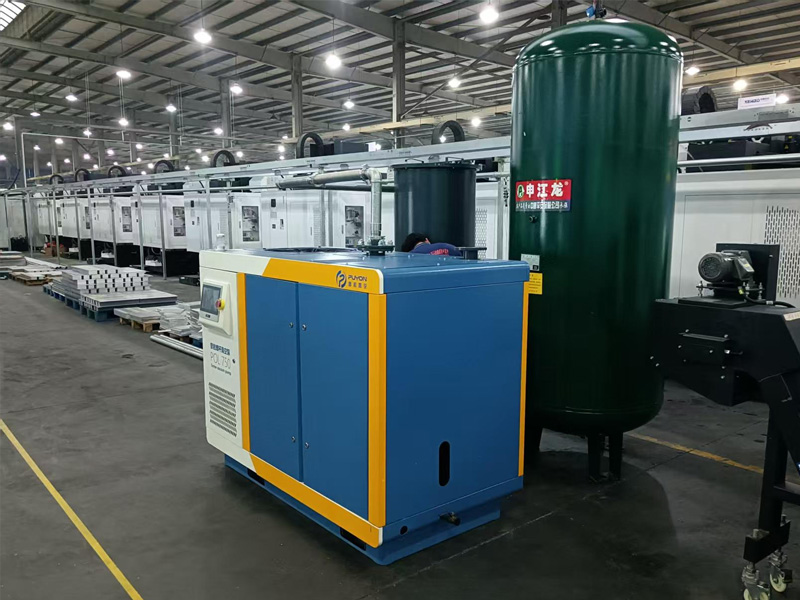
1. Energy Saving Principle: From "Fixed-Speed Operation" to "Energy on Demand"
Most traditional vacuum systems (such as water ring pumps and rotary vane pumps) are driven by fixed-frequency motors. Once started, they run at full constant speed regardless of the actual air demand. However, in a CNC workshop, multiple machine tools do not always operate at full load simultaneously – some are changing tools, some are on standby, and some are processing small-area workpieces. At these times, the vacuum demand drops significantly. Since traditional pumps cannot slow down, the excess air can only be discharged through overflow valves or bypass valves, resulting in severe energy waste.
The oil-lubricated screw vacuum pump uses a built-in variable frequency drive to monitor the system vacuum in real time and automatically adjust the motor speed based on actual demand:
- When air demand is high, the motor runs at full speed to ensure sufficient pumping speed and vacuum level;
- When air demand decreases, the motor automatically slows down, reducing the pumping rate accordingly.
This "energy on demand" approach closely matches the energy consumption curve to the actual load, achieving energy savings of 30%–50% compared to traditional fixed-frequency pumps. In addition, variable frequency soft starting avoids the large current surge during motor startup, making the system more grid-friendly and extending the life of electrical components.
2. Stable Vacuum: Ensuring CNC Machining Accuracy
CNC machining requires extremely high stability of the vacuum level. If the vacuum fluctuates, the workpiece holding force will vary, which may cause micron-level displacement during machining. In mild cases, this leads to dimensional deviations; in severe cases, it can directly scrap both the tool and the workpiece.
The oil-lubricated screw pump itself inherently helps maintain high vacuum stability: the lubricating oil forms a dynamic seal between the screw rotors and the housing, significantly reducing internal leakage, allowing the pump to maintain a stable pumping speed over a wide pressure range. With variable frequency control, the system can quickly respond to pressure changes, keeping vacuum fluctuations within a very small range. This characteristic is particularly important for precision processes such as glass engraving, high-gloss machining, and PCB drilling.
3. Reliable and Durable: Reducing Maintenance and Downtime
The air in a CNC workshop often contains cutting fluid oil mist, dust, and trace moisture. Traditional rotary vane pumps have vanes and exhaust valves that are wear parts requiring regular replacement. Water ring pumps require a large amount of circulating water, and their water quality deteriorates over time, leading to reduced vacuum and high maintenance costs.
The oil-lubricated screw vacuum pump has clear design advantages:
- No wearing parts such as vanes or exhaust valves; the rotors engage without contact, resulting in extremely low wear;
- The lubricating oil continuously circulates, not only providing sealing and cooling but also carrying away any trace dust and oil mist that are drawn in, which are then discharged through the oil separator. The inside of the pump body is not prone to fouling;
- Most models can operate stably for long periods in environments containing oil mist and trace moisture, with maintenance intervals much longer than those of rotary vane pumps.
In actual CNC applications, maintenance of an oil-lubricated screw vacuum pump is typically limited to periodic oil and air filter changes. Compared to the frequent repairs required by multiple decentralized small pumps, this significantly reduces labor costs and downtime.
4. Quiet and Environmentally Friendly: Improving the Workshop Environment
Traditional vacuum pumps (especially older water ring pumps and rotary vane pumps) generate high noise and strong vibration during operation, often exceeding 75 decibels, which seriously affects the concentration and health of operators. Water ring pumps also produce large amounts of oily wastewater, creating environmental pressure.
Because the oil-lubricated screw vacuum pump runs at low to medium speeds most of the time, combined with soundproof enclosures and vibration-damping mounts, the overall noise can be reduced to below 70 decibels, with some well-designed units even reaching below 65 decibels. At the same time, the oil-lubricated screw pump uses a closed-loop oil circulation system with no wastewater discharge. The exhaust gas, after passing through a high-efficiency oil mist separator, has very low oil carryover, meeting clean production and environmental regulations.
5. Central Vacuum System: An Ideal Choice for Centralized Air Supply to Multiple Machines
For medium to large machining workshops with multiple CNC machines, the traditional practice is to equip each machine with its own vacuum pump. This "distributed" approach suffers from a large number of devices, high total energy consumption, many failure points, and poor heat dissipation.
The oil-lubricated screw vacuum pump is very suitable for building a central vacuum system: one or several variable frequency oil-lubricated screw pumps are centrally placed in a separate utility room, supplying vacuum to all CNC machines through a piping network. The advantages of a central system include:
- Further energy savings: A central system can be configured with multiple pump units, automatically determining the number of pumps to run and their respective speeds based on total air demand, achieving a "group control strategy" and avoiding redundant operation;
- Easier after-treatment: High-efficiency filters and oil removal devices can be centrally installed on the main pipeline to provide clean, dry vacuum for all machines;
- Reduced heat load and noise in the workshop: The pump units are located away from the machining area, so workers hear almost no vacuum pump noise, and there is no additional heat load in summer;
- More convenient maintenance: All equipment is in one place, allowing inspections, oil changes, and filter replacements to be completed in one go, without having to move between multiple machines.
Conclusion
The oil-lubricated screw vacuum pump is not an entirely new category of equipment, but compared to traditional CNC vacuum solutions, it achieves a qualitative leap in the four dimensions of energy saving, stability, reliability, and environmental friendliness. Through variable frequency speed control, it delivers "energy on demand"; through its oil-lubricated screw design, it ensures high vacuum stability and long service life; and it supports advanced applications such as central vacuum systems and heat recovery.
For CNC machining companies facing pain points such as high electricity costs, unstable vacuum, frequent maintenance, and environmental inspections, upgrading from an old vacuum solution to an oil-lubricated screw vacuum pump is a wise choice with a short payback period and significant overall benefits.