
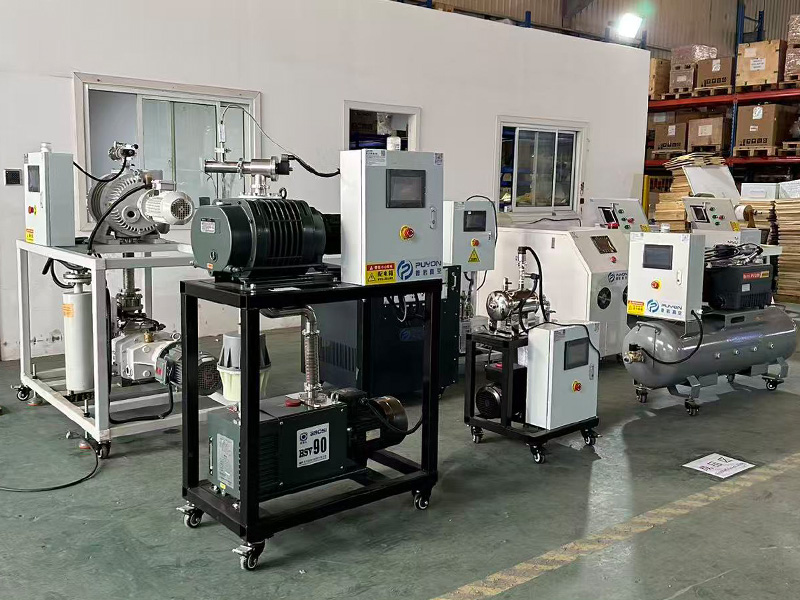
What is a vacuum pump system? In industrial production and scientific experiments, a single vacuum pump often struggles to meet both the requirements of "high vacuum level" and "large pumping speed". It is like wanting one person to both run fast and carry heavy loads – difficult to achieve with a single capability. This is where a vacuum pump system comes in – it combines two or more different types of vacuum pumps in a certain way, working together to achieve better overall performance than a single pump. Simply put, a vacuum pump system is not "one pump", but a "combined system of pumps". Through division of labor, it significantly improves pumping speed, ultimate vacuum, and process adaptability. Today, we will systematically explain: what is a vacuum pump system? What are its components? What are the common types? Where are they used?
1. Why do we need a vacuum pump system?
Although individual vacuum pumps each have their advantages, they also have obvious limitations:
- Rotary vane vacuum pump: High ultimate vacuum, but relatively low pumping speed, and not suitable for long-term direct exhaust of gases containing large amounts of water vapor or corrosive substances.
- Roots vacuum pump: High pumping speed, but cannot start directly at atmospheric pressure (otherwise it may overheat or be damaged); it requires a certain backing vacuum level before it can operate.
- Water ring vacuum pump: Can handle wet gases, but has a low ultimate vacuum (typically only about 3–5 kPa absolute pressure).
- Screw vacuum pump: Good overall performance, but extremely high cost for very high pumping speeds or ultra-high vacuum requirements.
The idea of a vacuum pump system is to complement strengths and overcome weaknesses. For example, using a Roots pump as the main pump for high pumping speed, and a rotary vane pump or screw pump as the backing pump to provide pre-vacuum and exhaust capability. This allows the entire system to have both high pumping speed and high ultimate vacuum, while adapting to more complex process gases.
2. Typical components of a vacuum pump system
A standard vacuum pump system typically includes the following core parts:
| Component | Function | Common forms |
|---|---|---|
| Main pump | Responsible for extracting most of the gas from the system and determines the pumping speed and ultimate vacuum level | Roots pump, turbomolecular pump, diffusion pump |
| Backing pump | Provides the necessary pre-vacuum conditions for the main pump, and evacuates the gas discharged from the main pump to the atmosphere | Rotary vane pump, screw pump, water ring pump, scroll pump |
| Valves and piping | Control gas flow direction, isolate pump units, enable bypass or venting | Electromagnetic vacuum valve, pneumatic butterfly valve, bellows |
| Vacuum measurement instruments | Monitor vacuum levels at various points in real time and transmit signals to the control system for automatic interlocking and control | Pirani gauge, hot cathode ionization gauge, diaphragm gauge |
| Control system | Automatically controls start/stop sequence, pressure interlocking, fault protection | PLC, digital pressure controller |
Take the most common Roots + rotary vane vacuum system as an example: during startup, the backing rotary vane pump starts first. When the system pressure drops to the allowable starting pressure of the Roots pump (e.g., 1–5 kPa), the Roots pump automatically starts, and together they evacuate the system to 0.1 Pa or even higher vacuum.
3. Common types and characteristics of vacuum pump systems
Depending on the combination of main pump and backing pump, vacuum pump systems can be divided into several types, each with its own features.
1. Roots rotary vane vacuum system
Composition: Roots pump + rotary vane backing pump
Characteristics: High pumping speed, vacuum level up to 0.1 Pa, relatively compact structure, moderate cost.
Applications: Vacuum coating, vacuum heat treatment, vacuum drying, capacitor vacuum impregnation, etc.
2. Dry roots screw vacuum system (Roots + screw)
Composition: Roots pump + oil-lubricated screw backing pump
Characteristics: Vacuum level up to 0.1 Pa, and the screw pump has better dry-running capability and can handle small amounts of moisture and dust; the variable frequency version is more energy-efficient.
Applications: Pharmaceuticals, chemicals, electronics, new energy, and other industries requiring clean vacuum and continuous operation.
3. Roots water ring vacuum system
Composition: Roots pump + water ring backing pump
Characteristics: The backing pump is a liquid ring pump, capable of withstanding wet gases and some dust, vacuum level approx. -100 kPa (gauge pressure).
Applications: Vacuum dewatering, vacuum distillation, building materials, power industry, and other processes with high humidity.
4. Turbo molecular pump system
Composition: Turbomolecular pump (main pump) + backing pump (rotary vane pump/scroll pump/screw pump)
Characteristics: Can achieve very high vacuum (10⁻⁵–10⁻⁷ Pa), oil-free or low oil, but low gas throughput and high cost.
Applications: Surface analysis instruments, electron microscopes, accelerators, high-end scientific research.
5. Diffusion pump system
Composition: Diffusion pump (main pump) + backing pump (rotary vane pump or screw pump)
Characteristics: The diffusion pump uses high-speed oil vapor jets to carry gas, has no moving parts, offers high reliability, and achieves high vacuum (10⁻⁴–10⁻⁶ Pa), but has a slightly higher risk of oil backstreaming than a turbomolecular pump, requiring a cold trap.
Applications: Vacuum coating, vacuum metallurgy, high vacuum furnaces, space simulation, and other traditional high vacuum applications.
4. Core advantages of vacuum pump systems
Compared to a single vacuum pump, a well-configured vacuum pump system offers the following significant advantages:
- High pumping speed, shorter cycle times: In large-volume vessels or continuous evacuation systems, a system can provide pumping speeds several times higher than a single pump, significantly reducing evacuation time.
- High ultimate vacuum: By connecting multiple stages in series, the ultimate vacuum limit of a single-stage pump is overcome, meeting the needs of high vacuum or even ultra-high vacuum processes.
- Good operational stability: The backing pump and main pump have distinct roles, protecting the main pump from overheating or overload under large pressure differences, making the system more reliable.
- Adaptability to complex gases: Different backing pumps (e.g., corrosion-resistant, moisture-tolerant) can be selected based on gas properties, expanding the application range of the system.
- Energy saving and intelligence: Modern systems commonly use PLC and VFD technology, enabling one-button start/stop, pressure interlocking, remote monitoring, and automatic speed reduction under partial load to save energy.
5. Main application fields of vacuum pump systems
Vacuum pump systems have penetrated many high-end manufacturing and scientific research scenarios. Common applications include:
- Vacuum coating: Optical coating, mobile phone glass AR coating, roll-to-roll coating equipment.
- Vacuum heat treatment: Vacuum brazing, vacuum sintering, vacuum annealing furnaces.
- Pharmaceuticals and chemicals: Vacuum distillation, molecular distillation, vacuum drying, vacuum crystallization.
- Semiconductors and electronics: PVD, CVD, etching, packaging, leak detection.
- Food and packaging: Central vacuum systems providing stable vacuum sources for multiple packaging lines.
- New energy: Lithium battery material drying, photovoltaic module lamination, hydrogen fuel cell production.
- Laboratories and research: Mass spectrometers, freeze dryers, space environment simulation.
6. How to choose a suitable vacuum pump system?
When selecting a vacuum pump system, it is recommended to focus on the following 5 factors:
- Required ultimate vacuum level of the process: Roughly determine whether you need rough vacuum, low vacuum, high vacuum, or ultra-high vacuum.
- Required pumping speed: Calculate based on the volume of the chamber and the allowable evacuation time.
- Gas composition: Does it contain condensable vapors, corrosive gases, dust, or flammable/explosive substances?
- Operation pattern: Intermittent or continuous? Is automatic control and remote monitoring needed?
- Energy efficiency and maintenance costs: For long-term operation, variable frequency oil-lubricated screw systems are often more cost-effective than traditional ones.
As a professional vacuum equipment solution provider, Shanghai Puyan Machinery Equipment Co., Ltd. can provide full-process services from selection calculation and system design to installation and commissioning based on your specific process parameters, making your vacuum system both "efficient" and "worry-free".
Conclusion
A vacuum pump system is not a simple pile-up of several pumps, but a systematically engineered vacuum solution with precise matching and control. Through the coordinated work of different types of vacuum pumps, it breaks through the performance boundaries of a single pump, achieving higher pumping speed, deeper vacuum, and stronger adaptability to operating conditions. Whether in a cleanroom for semiconductor manufacturing, a chemical distillation column, or a food packaging line, vacuum pump systems silently support the efficient operation of modern industry. If you would like to learn more about which type of vacuum pump system best suits your on-site needs, please follow Shanghai Puyan Machinery Equipment Co., Ltd. We will continue to provide professional and practical vacuum education content.