
What Is a Dry Rotary Vane Vacuum Pump?
What is an dry rotary vane vacuum pump? In the field of vacuum technology, the rotary vane vacuum pump is one of the most classic and widely used vacuum acquisition devices. Within this large family, the dry rotary vane vacuum pump (also known as the dry rotary vane vacuum pump) is playing a key role in more and more industries with zero tolerance for oil contamination, thanks to its unique "clean" characteristics.
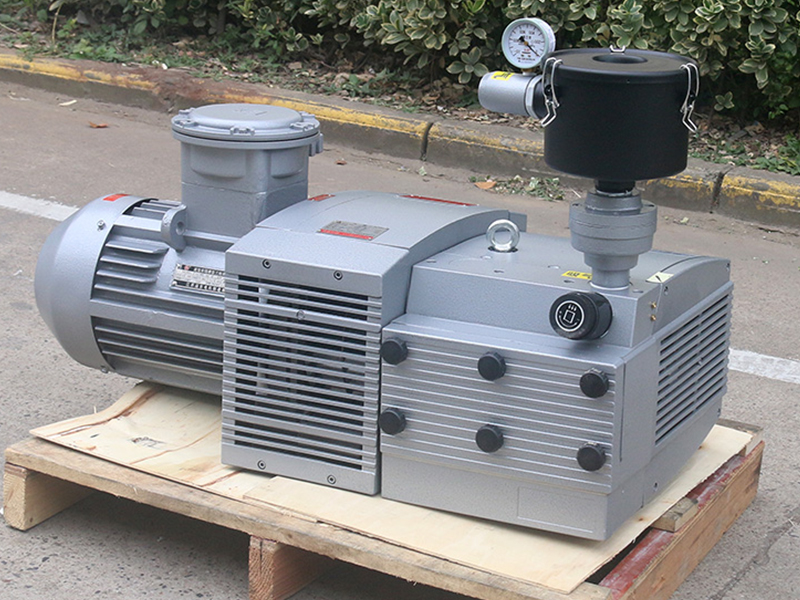
1. What is an dry rotary vane vacuum pump?
An dry rotary vane vacuum pump is a rotary vane vacuum pump that does not require oil, water, or any other working fluid in the pump chamber to participate in the gas compression process. It can start pumping from atmospheric pressure and discharge the pumped gas directly to the atmosphere.
The most fundamental difference between it and a traditional oil-lubricated rotary vane pump lies in the lubrication and sealing method:
- Oil-lubricated rotary vane pump: Relies on circulating pump oil to form an oil film between the rotor, vanes, and pump chamber, providing sealing, lubrication, and cooling.
- Oil-free rotary vane pump: Uses no lubricating oil at all. The vanes are made of self-lubricating materials (such as carbon or graphite composites). During high-speed rotation, the vanes are pressed against the pump chamber wall by centrifugal force, while the material properties provide the necessary lubrication, achieving "oil-free" operation.
The ultimate vacuum of an oil-free rotary vane pump typically reaches around 100 mbar(a) absolute pressure – this is a clear performance boundary and one of the most important reference parameters during selection.
2. Working principle
The working principle of an oil-free rotary vane pump is structurally consistent with that of an oil-lubricated rotary vane pump:
A cylindrical rotor is eccentrically mounted inside the pump chamber, with slots containing freely sliding vanes. When the motor drives the rotor to rotate at high speed, the vanes are thrown outward by centrifugal force and slide along the inner wall of the pump housing. The vanes divide the pump chamber into multiple independent working chambers.
As the rotor rotates continuously, the volume of these working chambers changes periodically:
- When volume increases – gas is drawn in through the inlet;
- When volume decreases – gas is compressed;
- After compression to a certain pressure – gas is discharged through the exhaust port.
Continuous operation achieves sustained evacuation of a sealed vessel. Throughout the entire process, the pump chamber contains no oil, no water, and no working fluid – the gas is not contaminated during compression and transfer.
3. Key characteristics
Advantages:
- Clean, oil-free operation: The extracted gas contains no oil vapor, and no oil emissions are generated. This makes it an ideal choice for applications with stringent gas cleanliness requirements, such as medical, food, electronics, and laboratory environments.
- Low maintenance cost: Eliminates the need for periodic oil changes and waste oil disposal associated with traditional oil pumps. Only regular cleaning of the inlet filter and inspection of vane wear are required.
- Environmentally friendly: No waste oil is produced, making it a "green vacuum pump" with no environmental pollution.
- Compact structure, low noise: Small footprint and smooth operation; some high-quality models can achieve noise levels around 55–60 dB.
- Stable operation: Low flow pulsation, suitable for applications requiring continuous and smooth pumping.
Limitations:
- Relatively low ultimate vacuum: Due to the absence of an oil film seal, internal leakage is greater, typically limiting ultimate vacuum to around 100 mbar(a), while oil-lubricated pumps can reach much higher levels. Therefore, they cannot meet the requirements of high-vacuum applications (such as vacuum coating or molecular distillation).
- Weaker heat dissipation: Oil not only seals but also carries away heat generated during operation. Oil-free pumps lack this liquid cooling, and pump body temperatures tend to rise during prolonged full-load operation.
- Sensitive to inlet contaminants: Precision clearances are easily blocked by dust and particles; high-precision inlet filters are typically required.
- Vane service life: Self-lubricating vanes (e.g., carbon vanes) are wear parts, and prolonged use in high-dust environments accelerates wear.
- Higher manufacturing cost: Clearances between the stator, rotor, and vanes must be controlled to micron levels, requiring high machining precision and material quality. For the same flow rate, the price is usually higher than that of oil-lubricated pumps.
4. Comparison with oil-lubricated rotary vane pumps
| Comparison dimension | dry rotary vane vacuum pump | Oil-lubricated rotary vane vacuum pump |
|---|---|---|
| Lubrication and sealing | Self-lubricating vanes (e.g., carbon, graphite), oil-free operation | Pump oil forms oil film for sealing, lubrication, and cooling |
| Ultimate vacuum | Lower, approx. 100 mbar(a) | Higher, approx. 0.1 mbar(a) |
| Cleanliness | Very high, oil-free and contaminant-free, clean exhaust | May produce oil mist, risk of oil backstreaming contamination |
| Maintenance cost | Low, no oil changes, simple maintenance | Requires periodic oil changes, filter replacements, waste oil disposal |
| Heat dissipation | Weaker, noticeable temperature rise during prolonged high-load operation | Oil circulation removes heat, better cooling |
| Typical applications | Rough vacuum applications with high cleanliness requirements | General industry with higher vacuum requirements |
5. Application fields
Due to its oil-free, clean nature, the dry rotary vane vacuum pump is widely used in a broad range of applications:
- Medical and pharmaceutical: Operating room suction, medical instrument integration, pharmaceutical vacuum drying, sterile packaging
- Food processing: Vacuum packaging, vacuum degassing for freshness preservation, vacuum concentration
- Electronics and semiconductor: Semiconductor wafer handling and fixing, electronic component packaging
- Laboratory and research: Gas analysis, physical and chemical experiments, vacuum filtration, vacuum drying
- Industrial automation: Paper suction in printing machinery, vacuum blister forming, vacuum suction cup fixtures
- Vacuum packaging and filling: Bag opening and filling in automatic packaging lines, liquid vacuum filling
6. Selection considerations
When selecting an dry rotary vane vacuum pump, several key points are worth noting:
- Vacuum requirement: Oil-free rotary vane pumps are suitable for rough vacuum applications (ultimate approx. 100 mbar(a)). If the process requires higher vacuum (e.g., below 10 Pa), other pump types should be considered.
- Gas cleanliness: Does the pumped gas contain large amounts of dust or particles? If so, an inlet filter is required to prevent accelerated vane wear.
- Operating load: Does the pump need to run continuously at full load for extended periods? Oil-free pumps have limited heat dissipation capacity; prolonged high-load operation may cause excessive temperature rise.
- Cost and budget: Oil-free rotary vane pumps are technically sophisticated and precision-manufactured, typically costing more than oil pumps of the same specifications, but long-term maintenance costs are lower.
Conclusion
The dry rotary vane vacuum pump is an important branch of the rotary vane pump family. It inherits the classic principle of "eccentric rotation and volumetric change" of vane pumps, but through the innovation of self-lubricating vane materials, it completely eliminates the dependence on pump oil.
Its core value lies in providing a clean, contaminant-free vacuum environment without using any working fluid. Although its ultimate vacuum is lower than that of oil pumps, in rough vacuum scenarios where cleanliness is strictly required – such as medical, food, electronics, and laboratory applications – the oil-free rotary vane pump stands out as an irreplaceable choice due to its oil-free operation, simple maintenance, and environmental friendliness.
Understanding its working principle, performance boundaries, and suitable applications is the first step toward correct selection and rational investment.