
The oil-lubricated screw vacuum pump has represented a breakthrough technological upgrade in the industrial vacuum field in recent years. To understand its value, we need to start with a common phenomenon: in traditional industrial vacuum systems, vacuum pumps often run at a constant speed. Regardless of the actual vacuum demand of the process, the pump operates at full speed with a fixed frequency. This is like keeping the accelerator fully pressed on a highway regardless of traffic – a large amount of electrical energy is wasted in the form of no-load operation, overflow, or noise. The core of the oil-lubricated screw vacuum pump is to add a variable frequency drive (VFD) system to the oil-lubricated screw pump, achieving "energy on demand" – more pumping when demand is high, less when demand is low, so that energy consumption always matches the actual load. Combined with the more efficient permanent magnet synchronous motor, the permanent magnet oil-lubricated screw vacuum pump – which currently offers the most outstanding energy savings – is born.
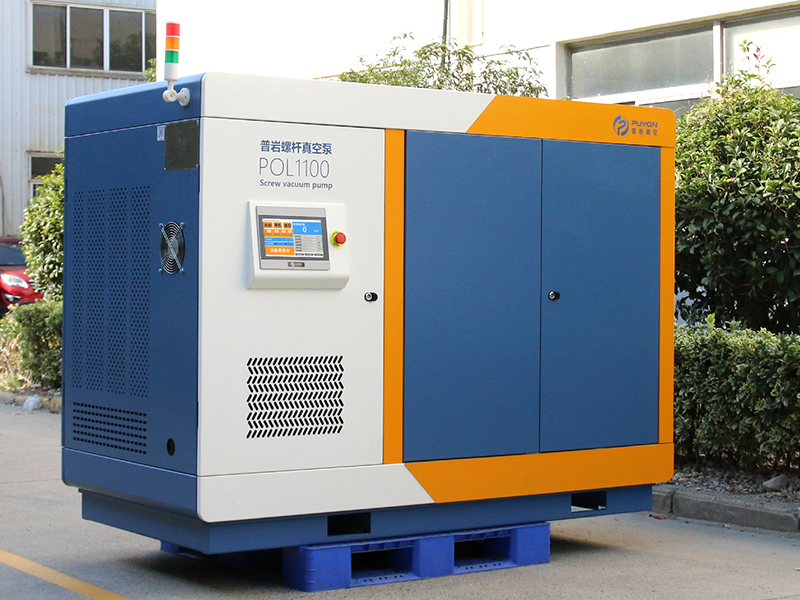
1. Basic principle of oil-lubricated screw vacuum pumps
The oil-lubricated screw vacuum pump is first and foremost a positive displacement twin-screw pump. Its core working principle is straightforward: inside the pump chamber, a pair of precisely meshing male and female screw rotors rotates synchronously in opposite directions at high speed, driven by the motor, completing the continuous cycle of "suction – compression – exhaust". During this process, oil plays three critical roles – sealing the rotor clearances to improve volumetric efficiency, lubricating metal parts to reduce friction, and carrying away compression heat for cooling and temperature control. After three stages of oil separation, the oil carryover in the exhaust can be controlled to a very low level, meeting environmental and clean production standards. It is on this efficient and stable mechanical foundation, combined with variable frequency control capability, that the more intelligent oil-lubricated screw vacuum pump is born.
2. What does variable frequency technology bring to vacuum pumps?
The term "variable frequency" is the soul of this technology.
2.1 Energy on demand, eliminating no-load waste
Traditional fixed-frequency vacuum pumps only have two states: "on" and "off". They start and stop frequently and have a lot of no-load operation, resulting in significant energy waste. The VFD control system, on the other hand, intelligently senses the real-time vacuum demand of the system and dynamically adjusts the motor speed: when the process demand is high, the VFD increases the motor speed to boost pumping capacity; when demand decreases, the VFD automatically reduces the speed so that the pumping capacity precisely matches the actual demand. This "as much as needed" operating mode fundamentally eliminates the high energy consumption of fixed-frequency equipment, achieving comprehensive energy savings of up to 50%.
2.2 Intelligent control and stable output
VFD control also brings superior process stability. The intelligent controller enables PID speed regulation, real-time monitoring, fault self-diagnostics, and remote connectivity, making the pump's operating status clear at a glance. VFD soft starting avoids the large current surge associated with traditional motor start/stop, extending equipment life and reducing grid load.
2.3 Low-noise operation and environmental friendliness
Because VFD adjustment allows the pump to run most of the time at lower speeds, combined with a quiet housing design, operating noise can be controlled below 72 dB(A), which is 10–15 dB lower than traditional pumps, significantly improving the workshop environment. At the same time, VFD control reduces start/stop shocks, improves oil separation efficiency, extends maintenance intervals, and greatly reduces the frequency of consumable replacement.
3. Permanent magnet VFD vs. ordinary VFD – which is more energy-efficient?
Building on the standard oil-lubricated screw vacuum pump, the permanent magnet oil-lubricated screw vacuum pump takes another big step forward. The combination of a permanent magnet synchronous motor (PMSM) and variable frequency technology is a perfect match in the field of motor control. The main difference between the two lies in the type of drive motor:
- Permanent magnet synchronous motor: The rotor uses permanent magnet material to generate the excitation field, requiring no excitation current, thus eliminating rotor losses. This feature makes the PMSM significantly more efficient than traditional asynchronous motors – an efficiency improvement of 7–10% compared to three-phase asynchronous motors. Even when a three-phase asynchronous motor is also equipped with VFD control, the permanent magnet VFD solution still has an 11–15% advantage.
- More importantly, high efficiency across all operating conditions: The efficiency of asynchronous motors drops sharply at low speeds, sometimes below 50%, while permanent magnet synchronous motors maintain high efficiency over a wide speed range, with an even more pronounced advantage under light load and low-speed conditions. This means that on an actual production line, when the vacuum pump operates under partial load most of the time, the energy savings of the permanent magnet VFD solution far exceed what the nameplate data of a single motor might suggest.
In other words, an ordinary VFD motor "can adjust speed but efficiency fluctuates", while a permanent magnet VFD motor "can precisely adjust speed and maintain high efficiency across the entire speed range". Deeply integrating permanent magnet synchronous motor technology with VFD speed control achieves a "1+1>2" comprehensive energy efficiency benefit, saving 30%–40% compared to traditional fixed-frequency screw pumps.
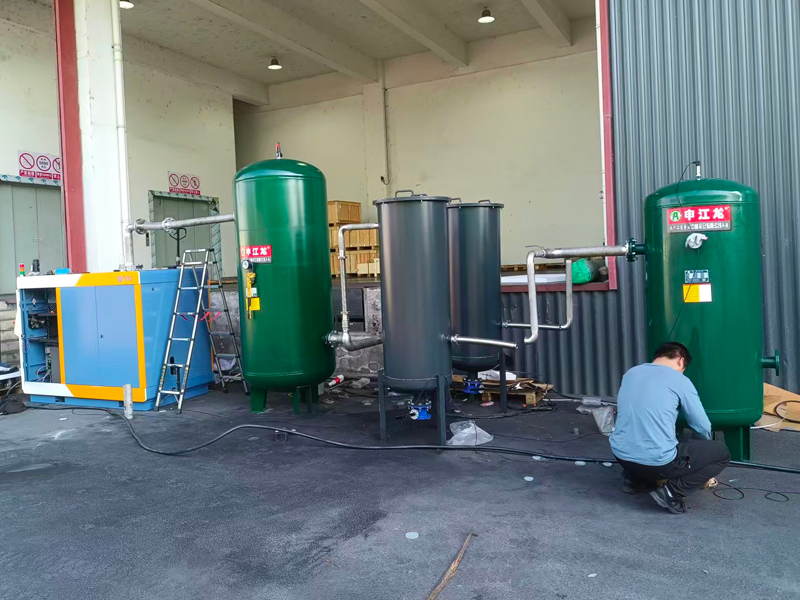
4. Application scenarios: Where are oil-lubricated screw vacuum pumps used?
The oil-lubricated screw vacuum pump offers a wide pumping speed range and stable vacuum levels, making it particularly suitable for medium to high vacuum applications requiring continuous production and minimal pressure fluctuations. It has been widely adopted in various high-end manufacturing fields.
- Electronics and semiconductor manufacturing: Central vacuum systems, coating, device packaging and other processes require long-term stable operation of the vacuum system. The VFD solution not only meets vacuum level requirements but also achieves significant energy savings.
- Photovoltaic industry: For processes such as battery material drying and module assembly, VFD control can achieve energy savings of over 30%.
- Chemical and pharmaceutical industries: Processes such as distillation, drying, degassing, and crystallization often involve handling gases containing solvents or water vapor. The oil-lubricated screw pump, with its excellent adaptability to operating conditions and stable output, has become a reliable choice in this field.
- Food packaging and processing: Processes such as vacuum packaging, freeze drying, and deaeration have high requirements for vacuum stability. VFD control ensures product quality consistency.
- New energy sector: Stringent vacuum system requirements for battery material drying, component assembly, etc. The VFD solution significantly reduces energy consumption while meeting process requirements.
It is worth noting that the oil-lubricated screw vacuum pump can operate either as a stand-alone unit or be integrated into a central vacuum system. A single unit can cover multiple production lines, providing centralized vacuum supply to multiple stations and avoiding wasteful duplicate purchases.
5. The choice for an energy-conscious era: global trends and application value
Today, industrial energy conservation has become a strategic priority worldwide. Governments across the globe are introducing policies to accelerate the adoption of high-efficiency motors and pumping equipment. For example, in many major industrial economies, regulations are pushing for greater market penetration of energy-efficient technologies in motors, fans, pumps, and compressors. Against this policy backdrop, energy-efficient vacuum equipment is shifting from being an "option" to a "necessity" for forward-thinking manufacturers.
The oil-lubricated screw vacuum pump is a representative product in this trend. Compared to traditional liquid-ring pumps and rotary vane pumps, oil-lubricated screw vacuum pumps offer comprehensive energy savings of 30%–50%. Coupled with the efficiency advantages of permanent magnet motors, the total life-cycle cost advantage is particularly striking. For production lines that run 24/7, the electricity cost savings from this efficiency improvement are substantial.
Conclusion
The oil-lubricated screw vacuum pump essentially equips the traditional oil-lubricated screw pump with an "intelligent brain" – through VFD-driven energy on demand, it fundamentally solves the long-standing problem of no-load energy waste in conventional vacuum equipment. The permanent magnet oil-lubricated screw vacuum pump further adopts a permanent magnet synchronous motor on the basis of VFD technology, delivering more efficient power output across the entire speed range and pushing energy-saving potential to new heights. As industrial manufacturing moves towards a greener, smarter, and higher-quality future, the oil-lubricated screw vacuum pump has become an indispensable tool for companies looking to reduce operating costs and enhance core competitiveness. For enterprises facing equipment renewal and energy-saving retrofits, this is not just an equipment-level upgrade, but a systemic efficiency revolution running through the entire production line.